Division
Equal Groups, Sharing, and Remainders
See it in groups. Build it in arrays. Own the facts.
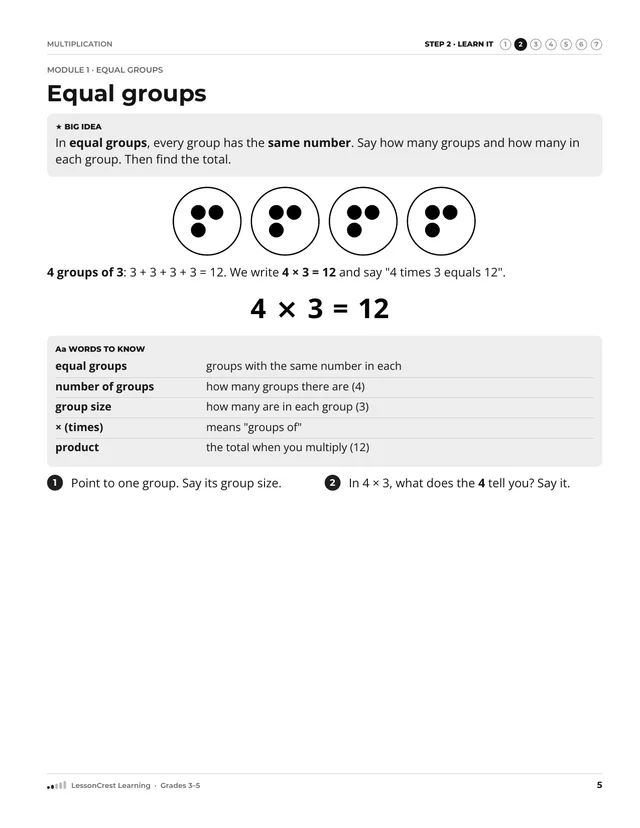
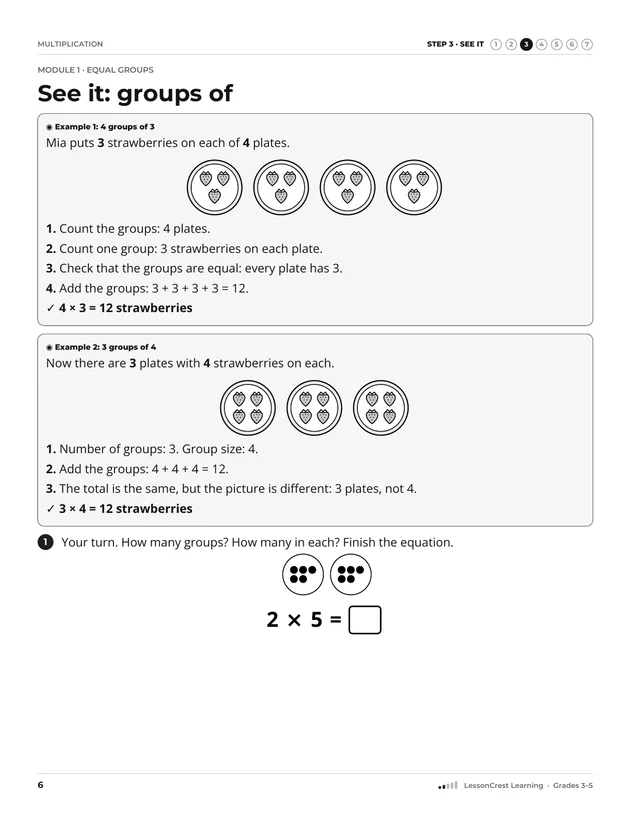
Four modules take learners from equal groups to arrays, turnaround facts, splitting hard facts into easy ones, and choosing multiplication in story problems. Every module follows the same seven LessonCrest steps, with help that fades as confidence grows.
Covered
What this book covers: facts up to 10 × 10 with equal groups, arrays, number lines, bar models, equations and story problems, and checking a product with division.
Not covered
Not covered here: long multiplication with bigger numbers, and division beyond checking a product (division has its own book in this series).
Before you start, you should be able to
- Count objects in small groups.
- Skip count by 2s and by 5s.
- Add the same number a few times.
- Find rows and columns.
Things to have
Let the learner build groups with real objects whenever it helps.
Notice
Pictures in this book are simplified learning models. Check answers with the explanations at the back of the book.
Check the skills you need before you begin. If something feels tricky, an adult can help you start in the right place.
Read a short, clear explanation of the new idea and the words that go with it.
Watch the idea being used, one step at a time, in a worked example.
Practice with prompts and help cues. The help gets smaller as you get stronger.
Practice on your own with different kinds of questions, and explain your thinking.
Look back at earlier learning so it stays strong, then check where to go next.
Check your answers. Each answer explains why, names a common mistake, and shows how to fix it.
Equal Groups, Sharing, and Remainders