Where to start
Choosing a book
Start with what the learner can already do. The grade on the cover is a rough guide, and each book tells you where to begin.
Start from the learner
Read page 2
Nearly every book says there what it covers and what it leaves out. Each book’s page here repeats them.
Use the readiness check
It is pages 3 and 4 of every book. In many of the books it includes a list headed “Before you start, you should be able to”. It ends in a table that points to a starting page instead of giving a score.
Follow the checkpoints
Every module ends in a checkpoint. Its table says which page to go back to, or to go on to the next module.
What the readiness check tells you
The check ends in a table. Each row describes a kind of difficulty and says what to do next: start at page 5, start with a particular kind of help, or do something simpler first.
If a skill is missing, the table may point to an earlier book or a short lesson. This can happen at any grade: Integer Operations: From Number Lines to Rules, a Grades 6–8 book, sends some learners back to Number Sense, a Grades K–2 book.
Where to start. Look at the kind of question you missed, not the score.
Grade by grade
Where a book names the next one to use, the books are listed in that order.
Grades K–2
These books are written to be used with an adult, who reads the directions aloud.
Math
Start with Number Sense if counting and comparing to 20 is not yet steady.
Grades 6–8
Math
- Integer Operations: From Number Lines to Rules
- Expressions and One-Variable Equations
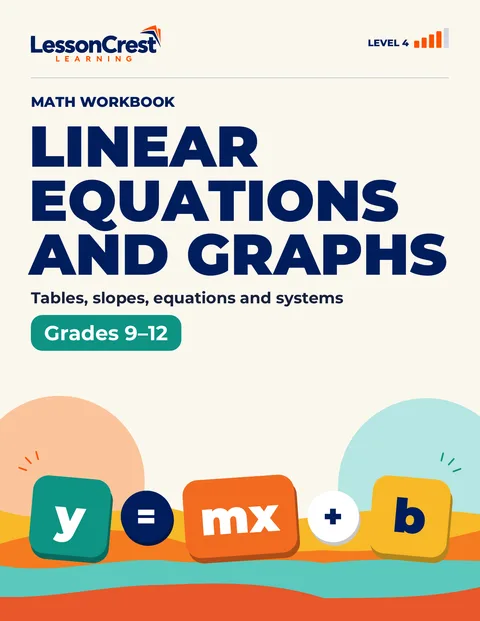
- Linear Equations and Graphs, Grades 9–12
A readiness check may send a learner back to a Grades 3–5 book for multiplication, division, fractions or decimals.
Grades 9–12
Math
If equations or signed numbers feel shaky, page 2 of Linear Equations and Graphs points back to Expressions and One-Variable Equations or Integer Operations: From Number Lines to Rules.
Money skills
Intro College
Some of these books call themselves companions to a course.
Math
College Algebra: Functions and Graphs expects you to solve, factor and graph linear and quadratic equations already, and points to Linear Equations and Graphs and Quadratics: Patterns, Graphs, and Solutions for those.