About this book
Write so readers know exactly what you mean
This workbook helps learners in grades 3–5 use capital letters, end marks, commas, and quotation marks with purpose. Four short modules move from sentence beginnings and endings to commas in lists, dates, and places, then simple dialogue, and finally editing whole passages. Each module follows the same steps: learn the idea, see a worked example, practice with help, practice alone, and look back at earlier skills. The book follows common U.S. punctuation style and points out where more than one choice is accepted. An answer key explains every answer.
- A readiness check that suggests where to start
- Worked examples that show an editor’s thinking
- Checkpoints that point to the right page for review
- Mixed reviews, an exit check, and a retry page
- An answer key with reasons and common mistakes
With explained answers for every page
Look inside
What this book covers
Covered
- Your goal: use capital letters, end marks, commas, and quotation marks so readers understand exactly what you mean.
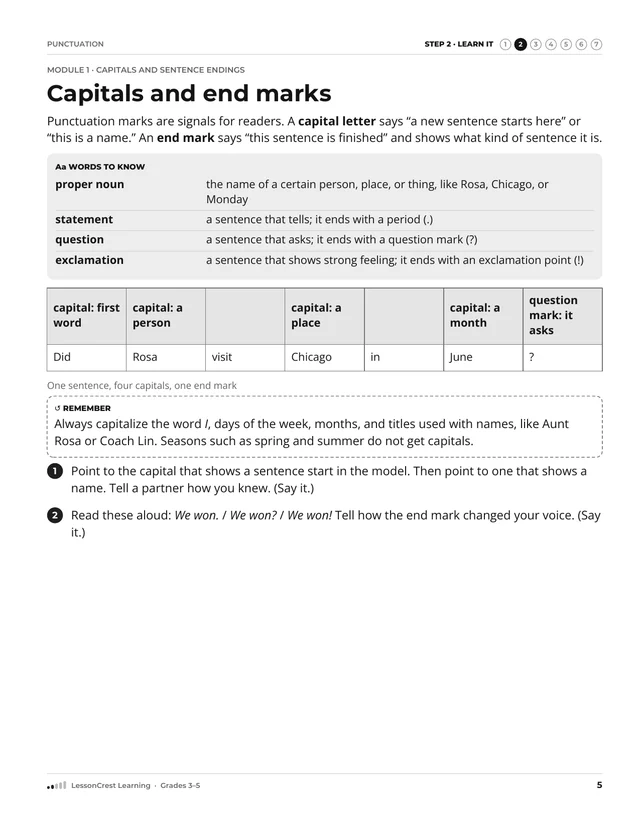
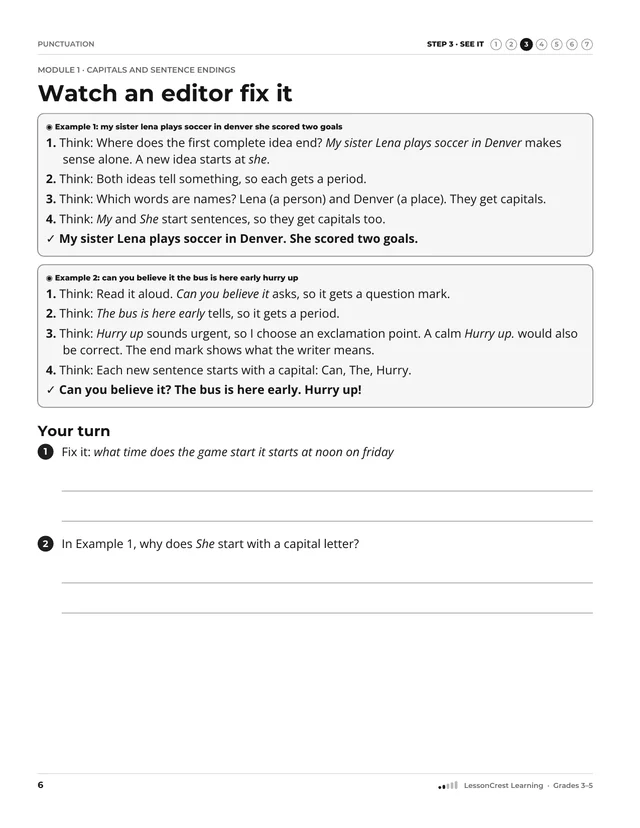
- You will learn capitals for sentence starts and names; periods, question marks, and exclamation points; commas in lists, dates, and city-and-state places; and simple dialogue.
Not covered
This book does not teach colons, semicolons, apostrophes, or long split quotations.
Notice
Pictures in this book are simplified learning models. Check answers with the explanations at the back of the book.
The steps in this book
- Step 1: Get Ready
Check the skills you need before you begin. If something feels tricky, an adult can help you start in the right place.
- Step 2: Learn It
Read a short, clear explanation of the new idea and the words that go with it.
- Step 3: See It
Watch the idea being used, one step at a time, in a worked example.
- Step 4: Try It Together
Practice with prompts and help cues. The help gets smaller as you get stronger.
- Step 5: On Your Own
Practice on your own with different kinds of questions, and explain your thinking.
- Step 6: Look Back
Look back at earlier learning so it stays strong, then check where to go next.
- Step 7: Check and Fix
Check your answers. Each answer explains why, names a common mistake, and shows how to fix it.
What is in the book
The modules
- Module 1: Capitals and sentence endingsPages 5–14
- Module 2: Commas in lists and datesPages 15–24
- Module 3: Simple dialoguePages 25–34
- Module 4: Editing in contextPages 35–44
Contents
- Readiness check, pp. 3–4. Before Module 1. Its table tells you where to start.
- Modules, pp. 5–44
- Checkpoints, pp. 14, 24, 34, 44. The last page of each module.
- Mixed review, pp. 45–48. Questions from across the book, mixed together.
- Exit check, pp. 49–50. A last check across the book.
- Reflect and repair, p. 51
- Try again, p. 52. Fresh questions like those in the exit check.
- Extra practice, p. 53
- Answers and explanations, pp. 54–64. Notes in this part are headed “Why”, “Common mistake”, “Help” and “Look for”.