College Study Skills: Notes, Retrieval, and Exam Preparation
About this book
Plan backward. Make notes you can test. Learn from every result.
A practical workbook for students starting college courses. You read fictional syllabi, plan two weeks around real-looking deadlines, turn dense lecture notes into questions, practice retrieval and problems over time, and review practice exams by error type. Every lesson follows the same seven steps and ends with explained answers.
- Audit a syllabus and plan backward with dependencies and buffer time
- Turn notes into concept maps and self-test prompts
- Space retrieval and move from worked examples to fresh problems
- Check calibration, classify errors and revise your plan
With explained answers for every task
Look inside
What this book covers
Covered
- Target skill. Coordinate course planning, selective note-making, retrieval, distributed problem practice and exam review, and judge your progress by evidence of what you can actually do.
- Covered: syllabus audits, backward planning, dependencies and buffer time; notes that become practice prompts; spaced retrieval, worked-example fading and mixed practice; practice exams, calibration, error logs and plan revision.
Not covered
- Not covered: a full biology or economics course (the excerpts are practice material), research-paper writing, or diagnosis of learning difficulties.
- No strategy here guarantees a grade.
Before you start, you should be able to
- find deadlines and requirements in a syllabus
- recall the main ideas of a short text
- summarize in your own words
- compare your work with feedback or a rubric
Notices
All courses, colleges, instructors and students in this book are fictional. The biology and economics excerpts are practice material, not a complete course. Study strategies are described with modest, evidence-based claims; no strategy guarantees a grade.
Pictures in this book are simplified learning models. Check answers with the explanations at the back of the book.
The steps in this book
- Step 1: Readiness Check
Short tasks show whether you can already read a syllabus, recall a passage and use feedback. A routing table suggests where to start; there is no fixed pass mark.
- Step 2: Concept
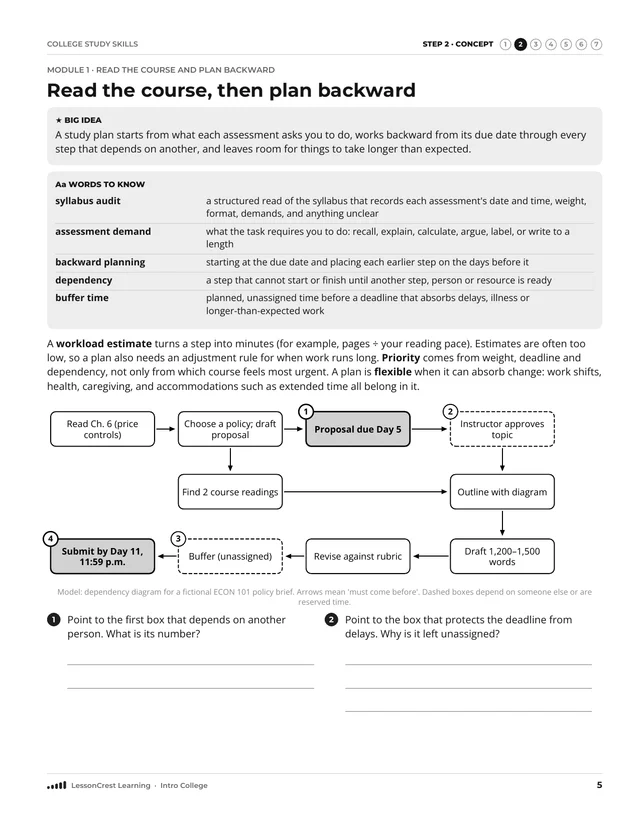
A plain explanation, key terms and a labeled model of the new idea.
- Step 3: Worked Example
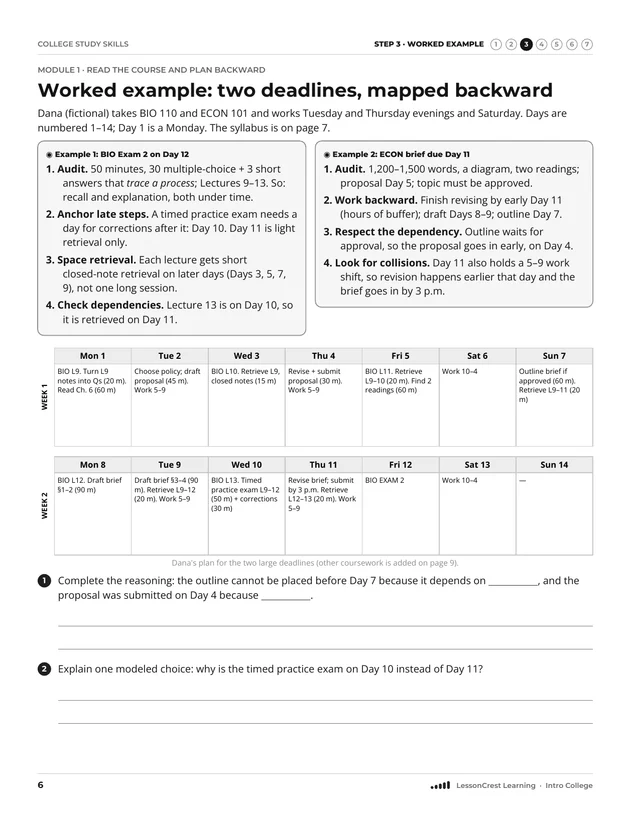
Two cases with the thinking shown, then a short completion check.
- Step 4: Guided Practice
Partial models and Help cues; the support fades on the second page.
- Step 5: Independent Practice
Varied tasks, a transfer task in a new course, and an error to diagnose and repair.
- Step 6: Review
Spaced review mixes earlier modules; checkpoints, cumulative reviews, exit checks and a retry show what to practice next.
- Step 7: Answers and Explanations
Each answer gives the reasoning, a common mistake and a page to revisit.
What is in the book
The modules
- Module 1: Read the course and plan backwardPages 5–14
- Module 2: Make notes that can become practicePages 15–24
- Module 3: Retrieve, explain, and solve over timePages 25–34
- Module 4: Prepare for exams and learn from resultsPages 35–44
Contents
- Readiness check, pp. 3–4. Before Module 1. Its table tells you where to start.
- Modules, pp. 5–44
- Checkpoints, pp. 14, 24, 34, 44. The last page of each module.
- Mixed review, pp. 45–48. Questions from across the book, mixed together.
- Exit check, pp. 49–50. A last check across the book.
- Reflect and repair, p. 51
- Try again, p. 52. Fresh questions like those in the exit check.
- Extra practice, p. 53
- Answers and explanations, pp. 54–64. Notes in this part are headed “Why”, “Common mistake”, “Help” and “Look for”.