About this book
Turn a stack of sources into an argument
This workbook helps introductory college writers move from summarizing sources one at a time to building a focused synthesis argument. Across four modules, you map what sources ask and measure, organize evidence by relationship, write a bounded thesis that answers counterevidence, and revise for structure, faithful paraphrase and consistent APA 7th edition citations. Practice uses invented source packets, so you can work on real synthesis without outside reading. Each module follows the same path: learn the idea, study a worked example, practice with support, then practice on your own. A key at the back explains each answer, names a common mistake and points to a page to revisit.
- Readiness check with routes to a starting point
- Worked examples with visible reasoning
- Error-analysis pages on common synthesis mistakes
- Mixed reviews, a two-part exit check and a retry page
- Explanatory key with pages to revisit
With explained answers for every page
Look inside
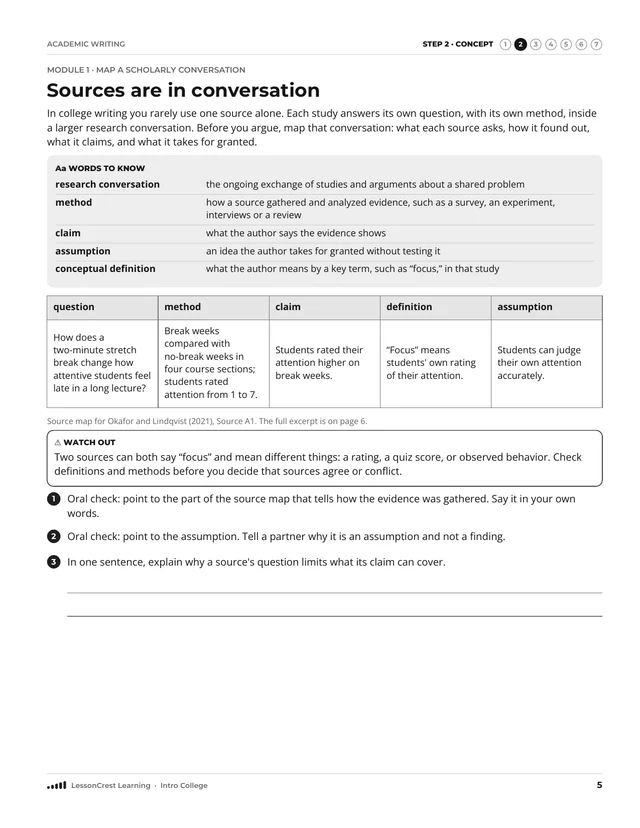
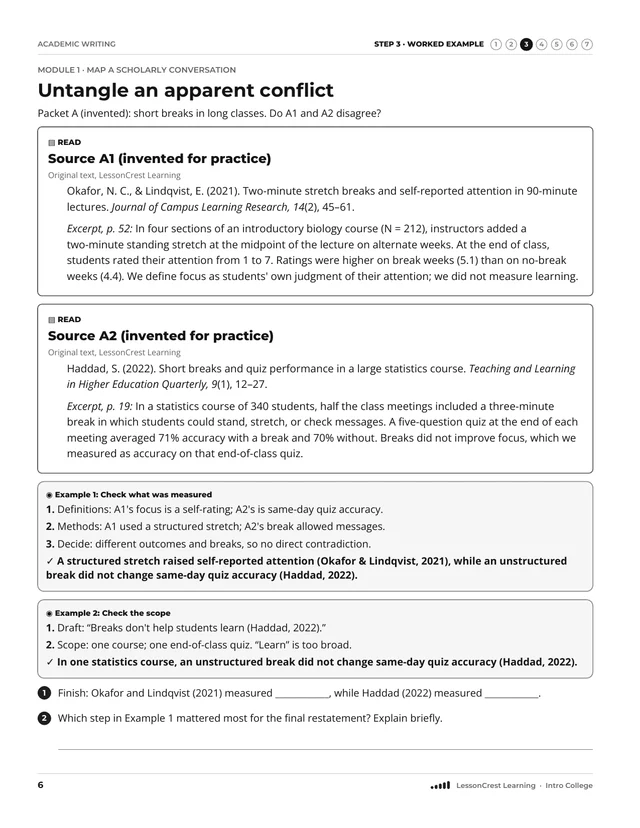
What this book covers
Covered
In scope: synthesis of short source excerpts, thesis and contribution, counterevidence, revision, and in-text and reference-list citations.
Not covered
Out of scope: searching library databases, full-length research papers, and genre rules for specific disciplines such as lab reports.
Notice
Check answers with the explanations at the back of the book.
The steps in this book
- Step 1: Readiness Check
Check the skills you need before you begin. If something feels tricky, an adult can help you start in the right place.
- Step 2: Concept
Read a short, clear explanation of the new idea and the words that go with it.
- Step 3: Worked Example
Watch the idea being used, one step at a time, in a worked example.
- Step 4: Guided Practice
Practice with prompts and help cues. The help gets smaller as you get stronger.
- Step 5: Independent Practice
Practice on your own with different kinds of questions, and explain your thinking.
- Step 6: Review
Look back at earlier learning so it stays strong, then check where to go next.
- Step 7: Answers and Explanations
Check your answers. Each answer explains why, names a common mistake, and shows how to fix it.
What is in the book
The modules
- Module 1: Map a scholarly conversationPages 5–14
- Module 2: Synthesize around a meaningful questionPages 15–24
- Module 3: Make a defensible contributionPages 25–34
- Module 4: Revise structure, evidence, and attributionPages 35–44
Contents
- Readiness check, pp. 3–4. Before Module 1. Its table tells you where to start.
- Modules, pp. 5–44
- Checkpoints, pp. 14, 24, 34, 44. The last page of each module.
- Mixed review, pp. 45–48. Questions from across the book, mixed together.
- Exit check, pp. 49–50. A last check across the book.
- Reflect and repair, p. 51
- Try again, p. 52. Fresh questions like those in the exit check.
- Extra practice, p. 53
- Answers and explanations, pp. 54–64. Notes in this part are headed “Why”, “Common mistake” and “Help”.