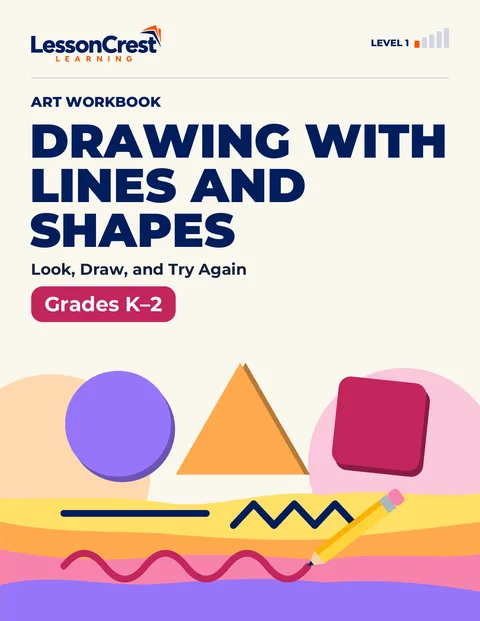
About this book
Look closely. Draw boldly. Try again.
Young artists explore light and heavy lines, build pictures from circles, triangles and rectangles, draw what they really see, and plan simple pictures. Every page invites a choice, so there is no single right drawing.
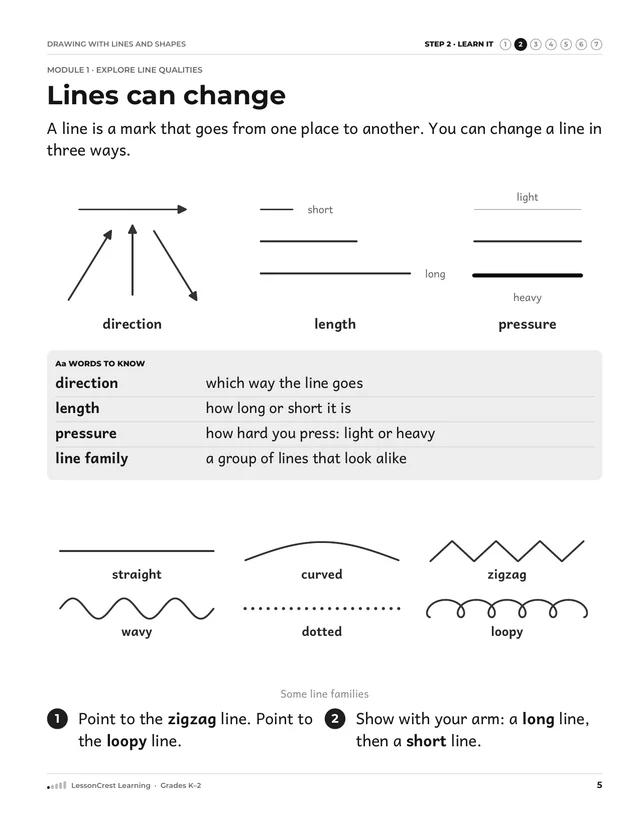
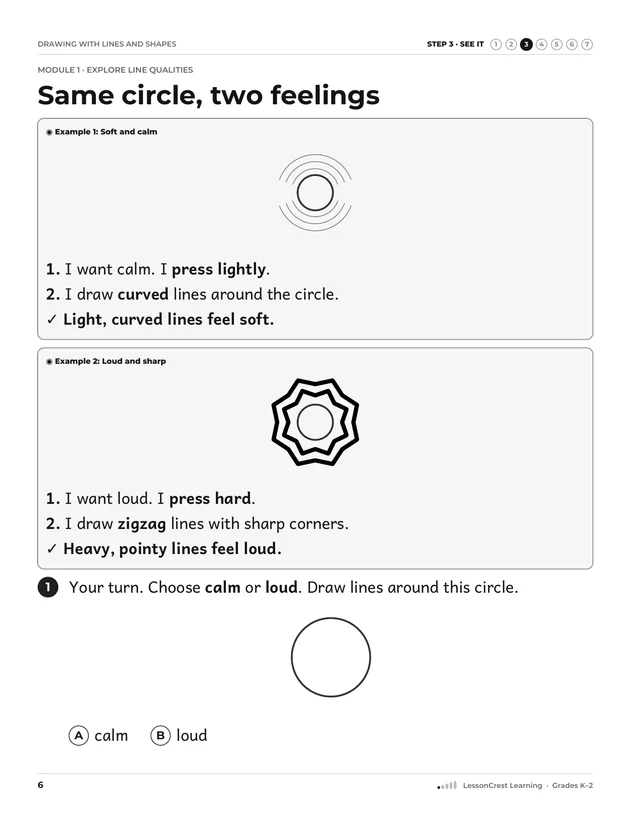
- Make lines that look windy, calm, bumpy or soft
- Build bikes, robots and machines from simple shapes
- Draw from real objects and try a second version
With an adult guide and answer notes for every page
Look inside
What this book covers
Covered
- Goal: Look closely and build drawings from lines and shapes.
- Make choices, compare, and improve one part.
Not covered
Not in this book: light-and-shadow shading, color mixing or perspective.
Before you start, you should be able to
- I can make marks with a pencil or crayon.
- I know a circle, a rectangle and a triangle.
Things to have
You need: a pencil, an eraser, crayons, and a cup, a bottle and an apple to look at.
Notice
Pictures in this book are simplified learning models. Check answers with the explanations at the back of the book.
The steps in this book
- Step 1: Get Ready
Check the skills you need before you begin. If something feels tricky, an adult can help you start in the right place.
- Step 2: Learn It
Read a short, clear explanation of the new idea and the words that go with it.
- Step 3: See It
Watch the idea being used, one step at a time, in a worked example.
- Step 4: Try It Together
Practice with prompts and help cues. The help gets smaller as you get stronger.
- Step 5: On Your Own
Practice on your own with different kinds of questions, and explain your thinking.
- Step 6: Look Back
Look back at earlier learning so it stays strong, then check where to go next.
- Step 7: Check and Fix
Check your answers. Each answer explains why, names a common mistake, and shows how to fix it.
What is in the book
The modules
- Module 1: Explore line qualitiesPages 5–14
- Module 2: Combine basic shapesPages 15–24
- Module 3: Observe edges and spacePages 25–34
- Module 4: Compose and revisePages 35–44
Contents
- Readiness check, pp. 3–4. Before Module 1. Its table tells you where to start.
- Modules, pp. 5–44
- Checkpoints, pp. 14, 24, 34, 44. The last page of each module.
- Mixed review, pp. 45–48. Questions from across the book, mixed together.
- Exit check, pp. 49–50. A last check across the book.
- Reflect and repair, p. 51
- Try again, p. 52. Fresh questions like those in the exit check.
- Extra practice, pp. 53–55
- Answers and explanations, pp. 56–64. Notes in this part are headed “Why”, “Common mistake”, “Help” and “Look for”.