About this book
Think like a coder with just a pencil.
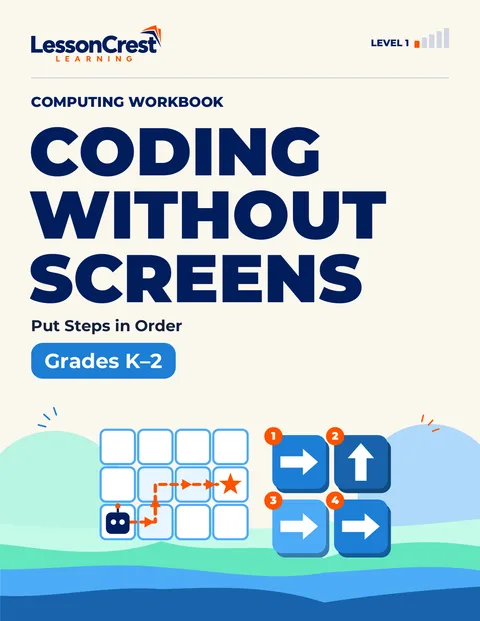
Children put picture steps in order, guide a paper robot with arrow commands, find and fix bugs, and spot steps that repeat. Every activity is unplugged, so no tablet or computer is needed.
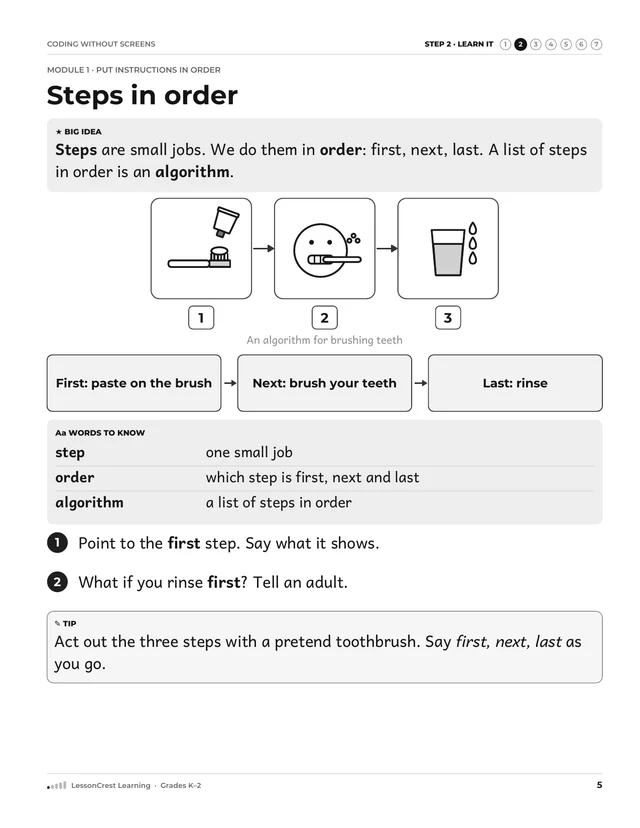
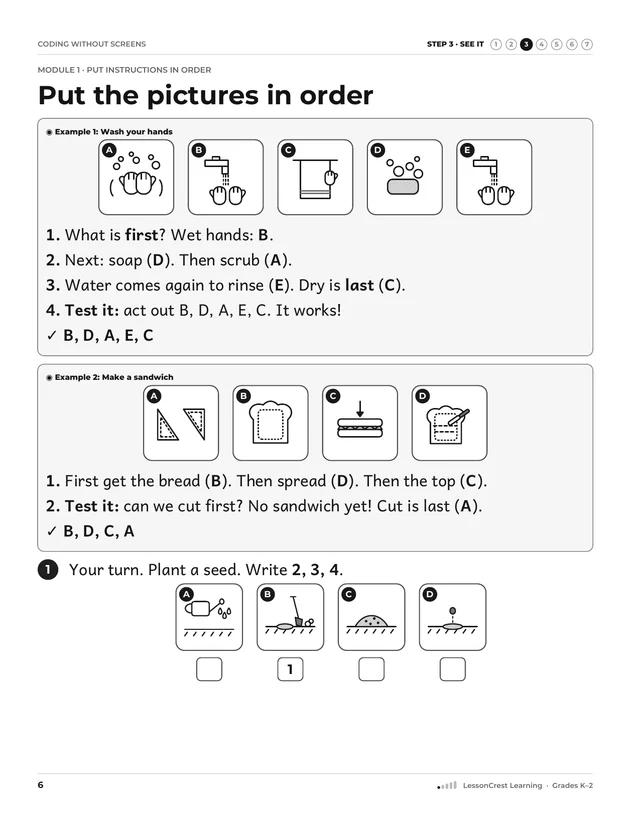
- Order everyday routines step by step
- Write and test exact arrow instructions
- Debug mistakes and use simple repeat loops
Screen-free activities with explained answers
Look inside
What this book covers
Covered
This book covers ordering steps, arrow commands, finding bugs and repeat cards.
Not covered
It does not teach typing or apps.
Before you start, you should be able to
- Follow two steps, like clap, then jump
- Spot things that happen in order
- Spot things that repeat
Things to have
- You need a pencil and crayons.
- A coin or small toy can be Bo the robot on the grids.
Notice
Pictures in this book are simplified learning models. Check answers with the explanations at the back of the book.
The steps in this book
- Step 1: Get Ready
Check the skills you need before you begin. If something feels tricky, an adult can help you start in the right place.
- Step 2: Learn It
Read a short, clear explanation of the new idea and the words that go with it.
- Step 3: See It
Watch the idea being used, one step at a time, in a worked example.
- Step 4: Try It Together
Practice with prompts and help cues. The help gets smaller as you get stronger.
- Step 5: On Your Own
Practice on your own with different kinds of questions, and explain your thinking.
- Step 6: Look Back
Look back at earlier learning so it stays strong, then check where to go next.
- Step 7: Check and Fix
Check your answers. Each answer explains why, names a common mistake, and shows how to fix it.
What is in the book
The modules
- Module 1: Put instructions in orderPages 5–14
- Module 2: Give precise commandsPages 15–24
- Module 3: Find and repair bugsPages 25–34
- Module 4: Recognize repeated stepsPages 35–44
Contents
- Readiness check, pp. 3–4. Before Module 1. Its table tells you where to start.
- Modules, pp. 5–44
- Checkpoints, pp. 14, 24, 34, 44. The last page of each module.
- Mixed review, pp. 45–48. Questions from across the book, mixed together.
- Exit check, pp. 49–50. A last check across the book.
- Reflect and repair, p. 51
- Try again, p. 52. Fresh questions like those in the exit check.
- Extra practice, pp. 53–55
- Answers and explanations, pp. 56–64. Notes in this part are headed “Why”, “Common mistake”, “Help” and “Look for”.