About this book
Think like a historian: when, how long, what changed, and how do we know?
Visit Riverbend, a made-up river town with 160 years of history, and learn the skills historians use. Put events in time order, build timelines with a fair scale, work out how long things lasted, compare pictures and sources from different years, and learn why ‘after’ is not the same as ‘because’.
- Time order, before and after, and reading dates
- Scaled timelines, durations, decades and centuries
- Change and continuity from drawn street scenes, maps, diaries and newspaper notices
- Fair questions about what a picture or diary can and cannot show
With explained answers for every page
Look inside
What this book covers
Covered
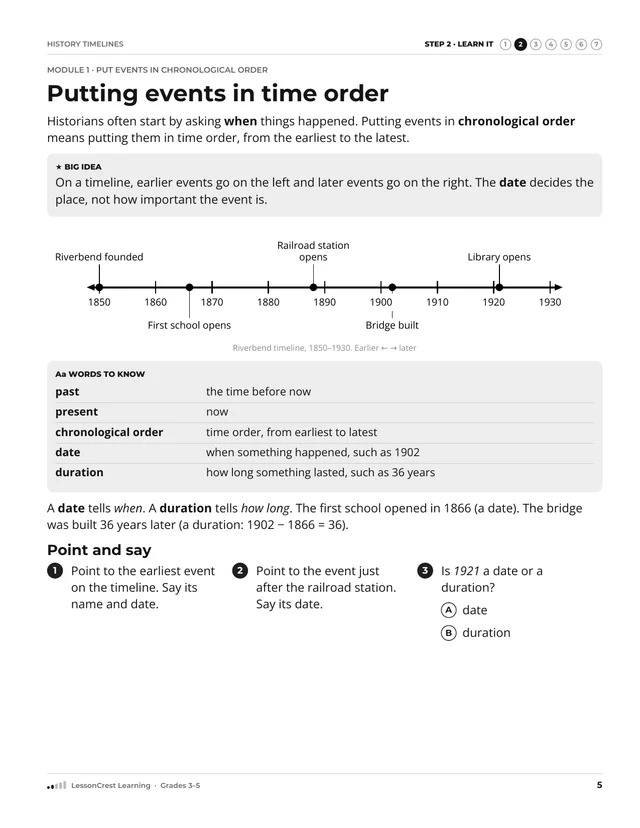
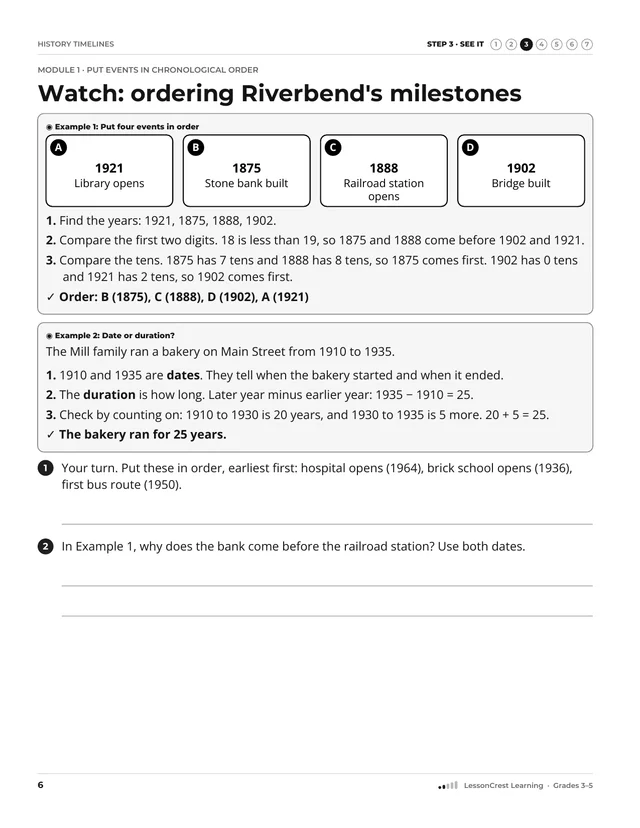
This book teaches four history skills: putting events in time order, reading timeline scales and finding durations, noticing change and continuity, and using sources to explain the past carefully.
Not covered
Not covered: memorising national history, BCE/CE dates, or judging in depth whether a source can be trusted.
Before you start, you should be able to
- I can compare years such as 1866 and 1902.
- I can tell then (long ago) from now.
- I know some kinds of things that come from the past.
Things to have
You will need a pencil, an eraser and a ruler.
Notices
Riverbend, its people, pictures and sources are invented for practice. Real historical dates are marked as real.
Pictures in this book are simplified learning models. Check answers with the explanations at the back of the book.
The steps in this book
- Step 1: Get Ready
Check the skills you need before you begin. If something feels tricky, an adult can help you start in the right place.
- Step 2: Learn It
Read a short, clear explanation of the new idea and the words that go with it.
- Step 3: See It
Watch the idea being used, one step at a time, in a worked example.
- Step 4: Try It Together
Practice with prompts and help cues. The help gets smaller as you get stronger.
- Step 5: On Your Own
Practice on your own with different kinds of questions, and explain your thinking.
- Step 6: Look Back
Look back at earlier learning so it stays strong, then check where to go next.
- Step 7: Check and Fix
Check your answers. Each answer explains why, names a common mistake, and shows how to fix it.
What is in the book
The modules
- Module 1: Put events in chronological orderPages 5–14
- Module 2: Read intervals and durationPages 15–24
- Module 3: Notice change and continuityPages 25–34
- Module 4: Connect timelines and sourcesPages 35–44
Contents
- Readiness check, pp. 3–4. Before Module 1. Its table tells you where to start.
- Modules, pp. 5–44
- Checkpoints, pp. 14, 24, 34, 44. The last page of each module.
- Mixed review, pp. 45–48. Questions from across the book, mixed together.
- Exit check, pp. 49–50. A last check across the book.
- Reflect and repair, p. 51
- Try again, p. 52. Fresh questions like those in the exit check.
- Extra practice, pp. 53–58
- Answers and explanations, pp. 59–64. Notes in this part are headed “Why”, “Common mistake”, “Help” and “Look for”.