About this book
Feel the beat. Clap the pattern. Read the notes.
Young musicians find a steady beat, echo long and short sounds, connect simple symbols to what they hear, and create their own four-beat patterns. Every activity can be done by clapping, tapping, moving or pointing.
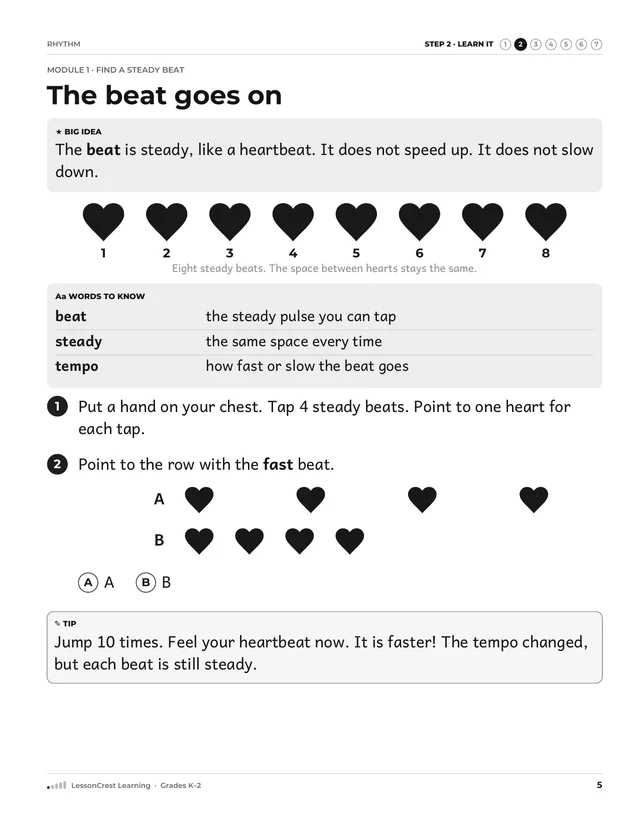
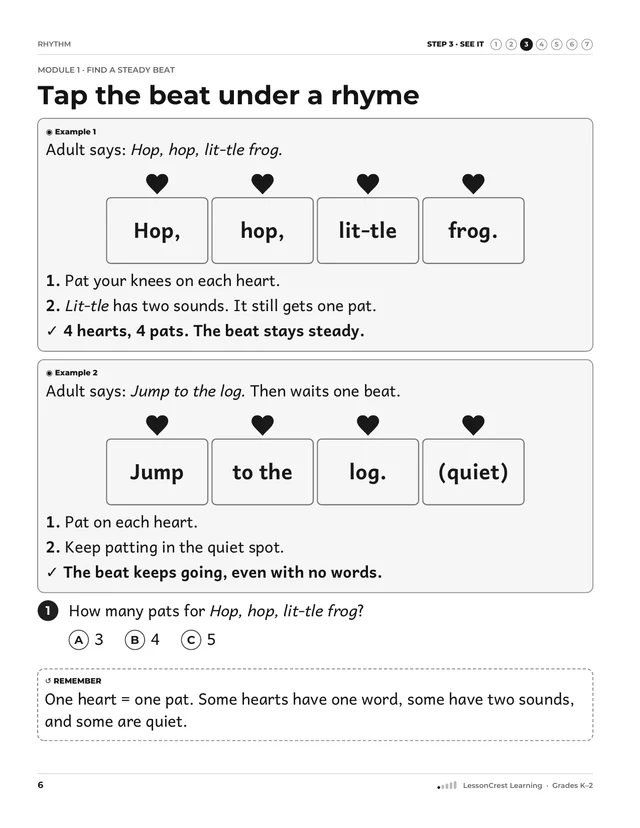
- Keep a steady beat with your body
- Hear and echo long and short sounds
- Read ta, ti-ti and rest, then compose a pattern
Adult read-aloud prompts and answer notes on every page
Look inside
What this book covers
Covered
- Goal: keep a steady beat, echo long and short sounds, read simple rhythm symbols and make your own rhythm.
- Covers beat, ta, ti-ti and rests in 4/4; not pitch, the staff or longer notes.
Not covered
There is no audio: the adult claps the pattern written in each Adult claps box.
Before you start, you should be able to
- Listen to a short sound pattern
- Choose a way to answer: clap, tap, pat, nod or point
Notice
Pictures in this book are simplified learning models. Check answers with the explanations at the back of the book.
The steps in this book
- Step 1: Get Ready
Check the skills you need before you begin. If something feels tricky, an adult can help you start in the right place.
- Step 2: Learn It
Read a short, clear explanation of the new idea and the words that go with it.
- Step 3: See It
Watch the idea being used, one step at a time, in a worked example.
- Step 4: Try It Together
Practice with prompts and help cues. The help gets smaller as you get stronger.
- Step 5: On Your Own
Practice on your own with different kinds of questions, and explain your thinking.
- Step 6: Look Back
Look back at earlier learning so it stays strong, then check where to go next.
- Step 7: Check and Fix
Check your answers. Each answer explains why, names a common mistake, and shows how to fix it.
What is in the book
The modules
- Module 1: Find a steady beatPages 5–14
- Module 2: Echo long and short soundsPages 15–24
- Module 3: Connect symbols to soundPages 25–34
- Module 4: Compose and perform a patternPages 35–44
Contents
- Readiness check, pp. 3–4. Before Module 1. Its table tells you where to start.
- Modules, pp. 5–44
- Checkpoints, pp. 14, 24, 34, 44. The last page of each module.
- Mixed review, pp. 45–48. Questions from across the book, mixed together.
- Exit check, pp. 49–50. A last check across the book.
- Reflect and repair, p. 51
- Try again, p. 52. Fresh questions like those in the exit check.
- Extra practice, pp. 53–54
- Answers and explanations, pp. 55–64. Notes in this part are headed “Why”, “Common mistake”, “Help” and “Look for”.