About this book
Every factor justified. Every answer explained.
A course companion for introductory college chemistry. Work from grams to moles to particles, use balanced equations as mole ratios, find limiting reagents and yields, and connect solution volumes to reacting amounts. Each module moves from a plain explanation and worked examples to guided, independent and mixed review practice.
- Dimensional analysis with SI prefixes and significant figures
- Mole ratios and mass-to-mass stoichiometry
- Limiting reagents, excess remaining and percent yield
- Molarity, dilution and titration-style calculations
With explained answers for every page
Look inside
What this book covers
Covered
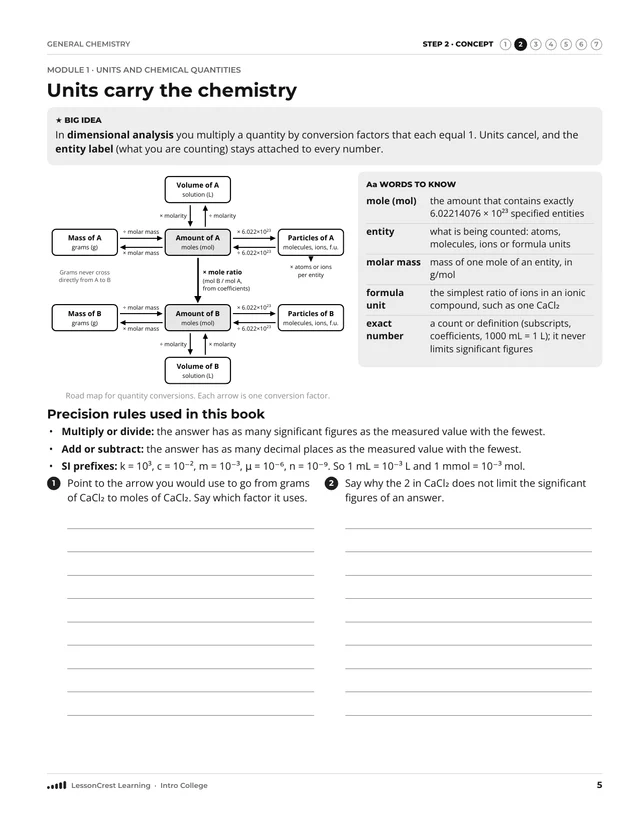
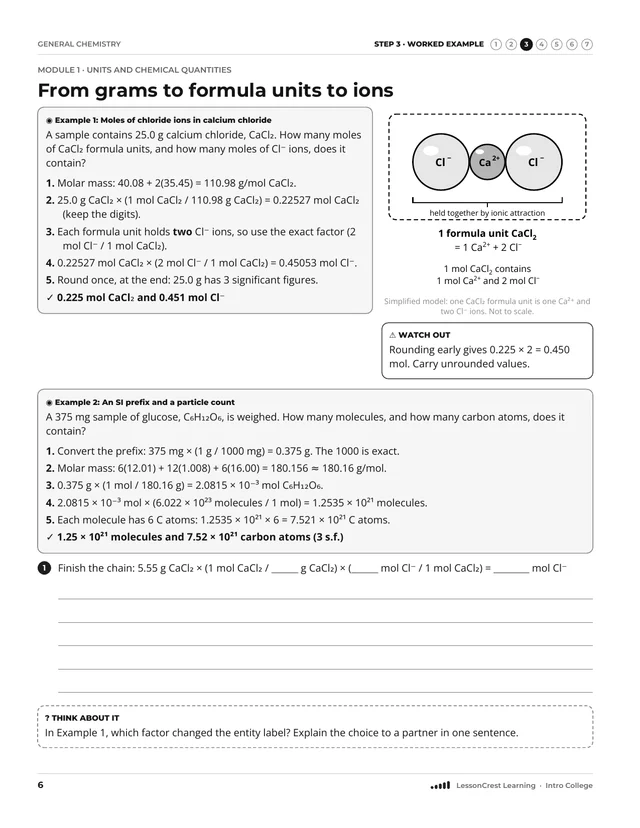
It practises calculations only: dimensional analysis, moles of compounds and of the atoms or ions inside them, mole ratios from balanced equations, limiting reagents and yields, and solution amounts (molarity, dilution and titration-style stoichiometry).
Not covered
- It contains no laboratory procedures, and no reaction in it should be attempted.
- Gas laws, equilibrium and thermochemistry are outside its scope.
Before you start, you should be able to
- I can balance a simple equation using coefficients.
- I can add atomic masses to find a molar mass and convert grams to moles.
- I can rearrange a formula such as M = n/V.
- I can use scientific notation and calculate a percentage.
- I can tell atoms, molecules, ions and formula units apart.
Notices
This book teaches chemistry calculations only. It contains no laboratory procedures; do not attempt any reaction described here.
Pictures in this book are simplified learning models. Check answers with the explanations at the back of the book.
The steps in this book
- Step 1: Readiness Check
Check the skills you need before you begin. If something feels tricky, an adult can help you start in the right place.
- Step 2: Concept
Read a short, clear explanation of the new idea and the words that go with it.
- Step 3: Worked Example
Watch the idea being used, one step at a time, in a worked example.
- Step 4: Guided Practice
Practice with prompts and help cues. The help gets smaller as you get stronger.
- Step 5: Independent Practice
Practice on your own with different kinds of questions, and explain your thinking.
- Step 6: Review
Look back at earlier learning so it stays strong, then check where to go next.
- Step 7: Answers and Explanations
Check your answers. Each answer explains why, names a common mistake, and shows how to fix it.
What is in the book
The modules
- Module 1: Units and chemical quantitiesPages 5–14
- Module 2: Balanced equations as quantitative modelsPages 15–24
- Module 3: Limiting reagents and yieldsPages 25–34
- Module 4: Solution quantities and reaction amountsPages 35–44
Contents
- Readiness check, pp. 3–4. Before Module 1. Its table tells you where to start.
- Modules, pp. 5–44
- Checkpoints, pp. 14, 24, 34, 44. The last page of each module.
- Mixed review, pp. 45–48. Questions from across the book, mixed together.
- Exit check, pp. 49–50. A last check across the book.
- Reflect and repair, p. 51
- Try again, p. 52. Fresh questions like those in the exit check.
- Extra practice, p. 53
- Answers and explanations, pp. 54–64. Notes in this part are headed “Why”, “Common mistake”, “Help” and “Look for”.