About this book
Build arguments that hold up
This workbook teaches students to write short arguments about everyday school and community decisions, such as library hours, recess timing, class pets and recycling. Learners narrow broad opinions into workable claims, connect reasons to evidence, explain what the evidence shows, respond fairly to other views, and revise their reasoning before polishing sentences. Every module follows the same learning cycle, from explanation and worked examples to guided and independent practice and review. All surveys, data and articles are invented for practice. An explanatory key gives answers, criteria for open tasks, common mistakes and pages to revisit.
- A readiness check with starting routes
- Four modules: claims, evidence, other views, revision
- Worked examples, guided and independent practice
- Invented evidence sets, organizers and a rubric
- Answer key with explanations and reteach pages
With explained answers for every page
Look inside
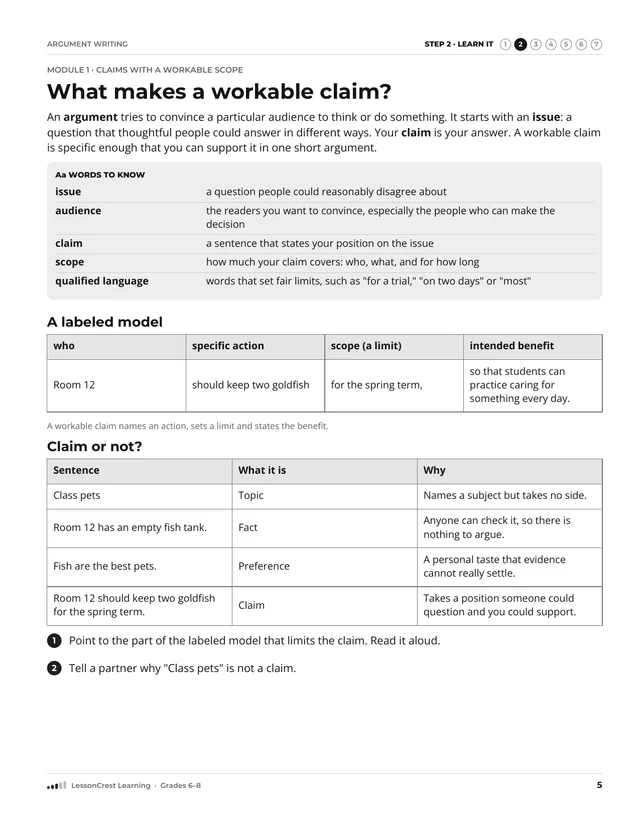
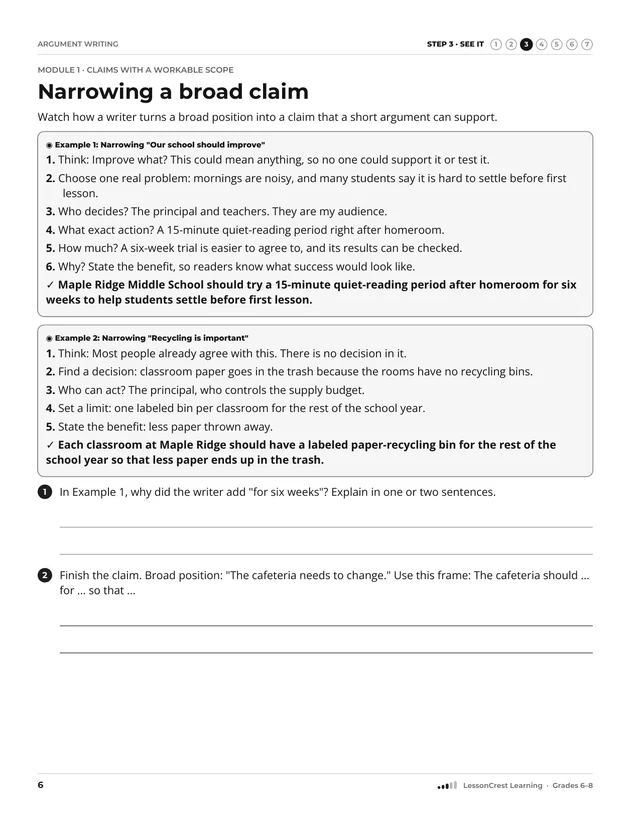
What this book covers
Covered
- Your goal: write a short argument with a clear, limited claim, evidence that you explain, a fair look at another view, and revisions that make the reasoning stronger.
- You will argue about everyday school and community decisions, such as library hours, recess timing, class pets and recycling.
Not covered
The book does not cover formal debate, advertising, long research papers or political issues.
Notice
Check answers with the explanations at the back of the book.
The steps in this book
- Step 1: Get Ready
Check the skills you need before you begin. If something feels tricky, an adult can help you start in the right place.
- Step 2: Learn It
Read a short, clear explanation of the new idea and the words that go with it.
- Step 3: See It
Watch the idea being used, one step at a time, in a worked example.
- Step 4: Try It Together
Practice with prompts and help cues. The help gets smaller as you get stronger.
- Step 5: On Your Own
Practice on your own with different kinds of questions, and explain your thinking.
- Step 6: Look Back
Look back at earlier learning so it stays strong, then check where to go next.
- Step 7: Check and Fix
Check your answers. Each answer explains why, names a common mistake, and shows how to fix it.
What is in the book
The modules
- Module 1: Claims with a workable scopePages 5–14
- Module 2: Reasons, evidence, and explanationPages 15–24
- Module 3: Respond to reasonable alternativesPages 25–34
- Module 4: Draft, revise, and verifyPages 35–44
Contents
- Readiness check, pp. 3–4. Before Module 1. Its table tells you where to start.
- Modules, pp. 5–44
- Checkpoints, pp. 14, 24, 34, 44. The last page of each module.
- Mixed review, pp. 45–48. Questions from across the book, mixed together.
- Exit check, pp. 49–50. A last check across the book.
- Reflect and repair, p. 51
- Try again, p. 52. Fresh questions like those in the exit check.
- Extra practice, p. 53
- Answers and explanations, pp. 54–64. Notes in this part are headed “Why”, “Common mistake” and “Help”.