About this book
Look closer. Explain how cells work.
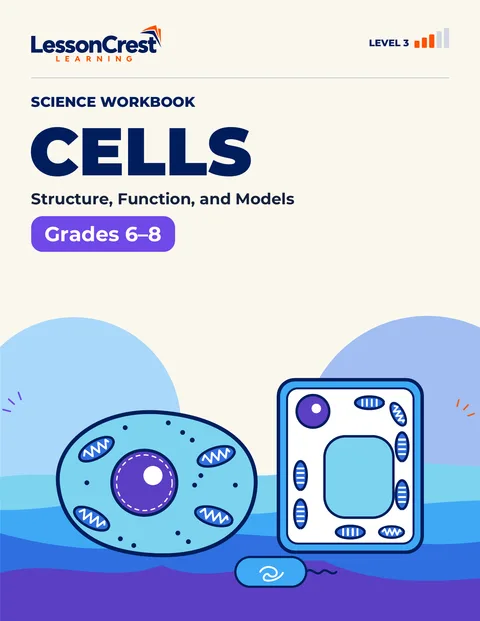
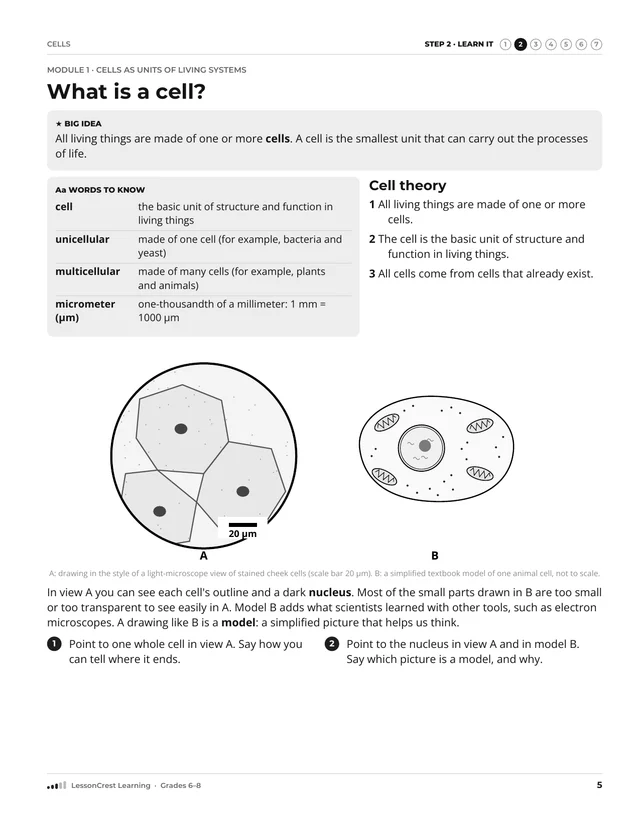
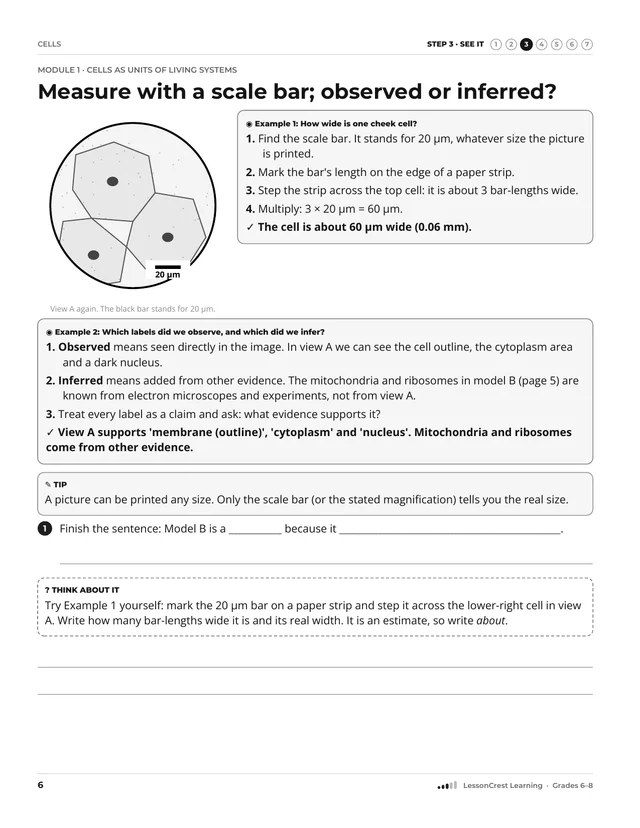
Cells is a guided science workbook for grades 6–8. Learners measure cell images with scale bars, label simplified plant, animal and bacterial cell models, connect structures to their jobs, and use a particle model to explain diffusion. Models come with notes on what they show and what they leave out.
- Read scale bars and magnification in cell pictures
- Label and compare plant, animal and bacterial cells
- Explain diffusion and how cells build tissues and organs
- Fix common mistakes with worked examples and checkpoints
With explained answers for every page
Look inside
What this book covers
Covered
- This book is about cells: what they are made of, what their parts do, how cell types differ, and how cells work together in a whole organism.
- You will read cell images, measure with scale bars, label simplified models and explain how structures and functions connect.
Not covered
It does not cover cell division, genetics or the chemistry of respiration and photosynthesis in detail; those come in later books.
Before you start, you should be able to
- Tell living things apart from non-living things
- Name a structure of a plant or animal and say what it does
- Explain how a drawing can show something you cannot see
- Read a ruler or scale in millimeters and centimeters
Things to have
Work in pencil.
Notices
This book teaches cell biology with simplified models. All activities use paper, pencil and everyday materials only; no lab chemicals, stains or sharp tools are needed.
Pictures in this book are simplified learning models. Check answers with the explanations at the back of the book.
The steps in this book
- Step 1: Get Ready
Check the skills you need before you begin. If something feels tricky, an adult can help you start in the right place.
- Step 2: Learn It
Read a short, clear explanation of the new idea and the words that go with it.
- Step 3: See It
Watch the idea being used, one step at a time, in a worked example.
- Step 4: Try It Together
Practice with prompts and help cues. The help gets smaller as you get stronger.
- Step 5: On Your Own
Practice on your own with different kinds of questions, and explain your thinking.
- Step 6: Look Back
Look back at earlier learning so it stays strong, then check where to go next.
- Step 7: Check and Fix
Check your answers. Each answer explains why, names a common mistake, and shows how to fix it.
What is in the book
The modules
- Module 1: Cells as units of living systemsPages 5–14
- Module 2: Structures support cellular functionsPages 15–24
- Module 3: Compare cell types carefullyPages 25–34
- Module 4: From cell needs to organism functionPages 35–44
Contents
- Readiness check, pp. 3–4. Before Module 1. Its table tells you where to start.
- Modules, pp. 5–44
- Checkpoints, pp. 14, 24, 34, 44. The last page of each module.
- Mixed review, pp. 45–48. Questions from across the book, mixed together.
- Exit check, pp. 49–50. A last check across the book.
- Reflect and repair, p. 51
- Try again, p. 52. Fresh questions like those in the exit check.
- Extra practice, p. 53
- Answers and explanations, pp. 54–64. Notes in this part are headed “Why”, “Common mistake”, “Help” and “Look for”.