About this book
Sentences that say what you mean
This workbook helps learners in grades 6–8 understand how sentences are built and why structure matters. Learners find independent and dependent clauses, repair fragments, comma splices, and run-ons, and join ideas with coordinating and subordinating conjunctions that fit the meaning. A final module revises for clear pronouns, parallel lists, and variety that serves meaning, not length. Each module moves from a short explanation and worked examples to guided practice and then practice on your own. Review pages, extra practice, an exit check, a retry page, and an answer key that explains common mistakes complete the book. Combining tasks accept several correct versions.
- Four modules: clauses, coordination, subordination, and revision
- Clear terms: simple, compound, complex, and compound-complex sentences
- Worked examples, guided practice, and varied independent tasks
- Checkpoints that point to pages for extra practice
- Answer key with explanations, common mistakes, and reteach pages
With explained answers for every page
Look inside
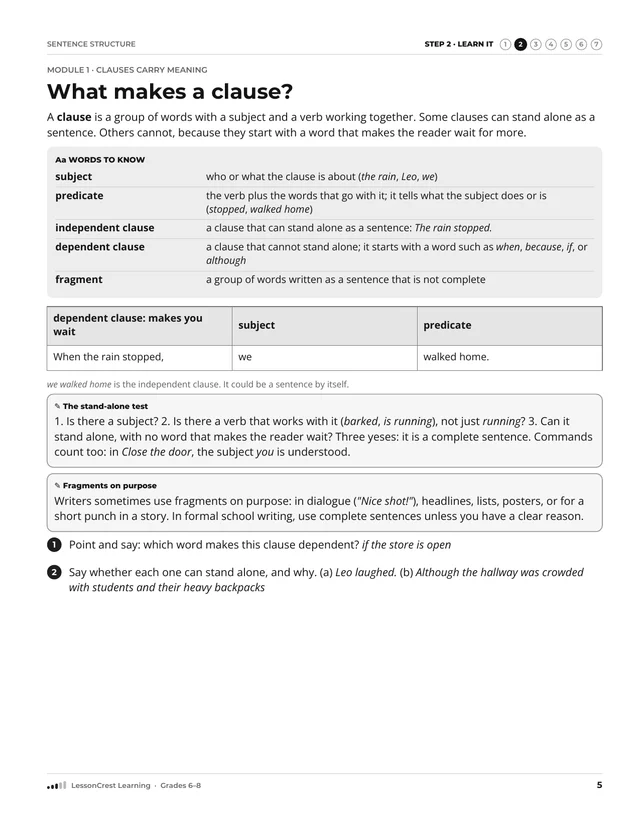
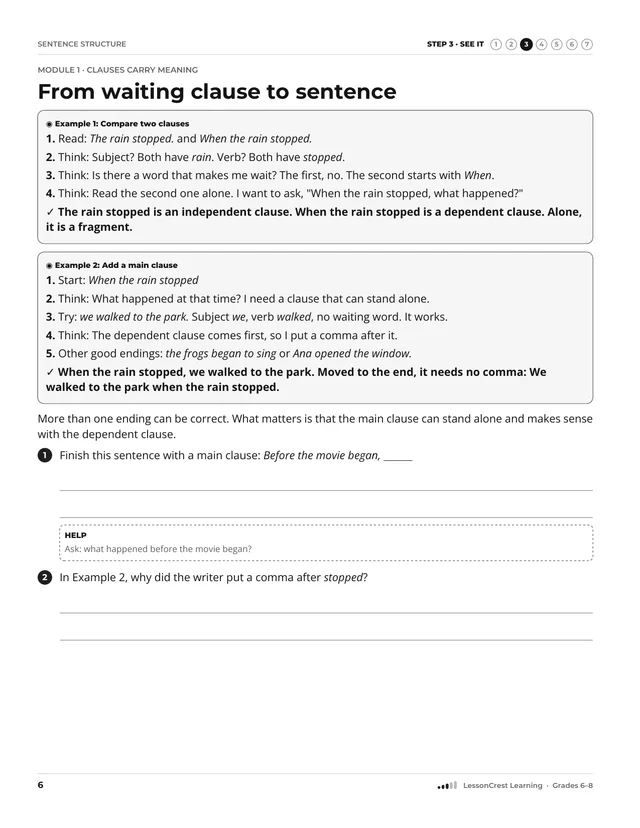
What this book covers
Covered
- This book helps you build sentences on purpose.
- You will tell independent clauses from dependent clauses, fix fragments, and join equal ideas.
- You will use dependent clauses to show time, reason, condition, and contrast.
Not covered
Not covered here: spelling, verb tenses in depth, and the full list of parts of speech.
Before you start
You only need to find subjects and verbs.
Notice
Check answers with the explanations at the back of the book.
The steps in this book
- Step 1: Get Ready
Check the skills you need before you begin. If something feels tricky, an adult can help you start in the right place.
- Step 2: Learn It
Read a short, clear explanation of the new idea and the words that go with it.
- Step 3: See It
Watch the idea being used, one step at a time, in a worked example.
- Step 4: Try It Together
Practice with prompts and help cues. The help gets smaller as you get stronger.
- Step 5: On Your Own
Practice on your own with different kinds of questions, and explain your thinking.
- Step 6: Look Back
Look back at earlier learning so it stays strong, then check where to go next.
- Step 7: Check and Fix
Check your answers. Each answer explains why, names a common mistake, and shows how to fix it.
What is in the book
The modules
- Module 1: Clauses carry meaningPages 5–14
- Module 2: Coordinate equal ideasPages 15–24
- Module 3: Subordinate to show relationshipsPages 25–34
- Module 4: Revise for rhythm and clarityPages 35–44
Contents
- Readiness check, pp. 3–4. Before Module 1. Its table tells you where to start.
- Modules, pp. 5–44
- Checkpoints, pp. 14, 24, 34, 44. The last page of each module.
- Mixed review, pp. 45–48. Questions from across the book, mixed together.
- Exit check, pp. 49–50. A last check across the book.
- Reflect and repair, p. 51
- Try again, p. 52. Fresh questions like those in the exit check.
- Extra practice, pp. 53–54
- Answers and explanations, pp. 55–64. Notes in this part are headed “Why”, “Common mistake” and “Help”.