Quadratics: Patterns, Graphs, and Solutions
Tables, forms, methods, and models
See where a function is heading, then measure how fast it changes.
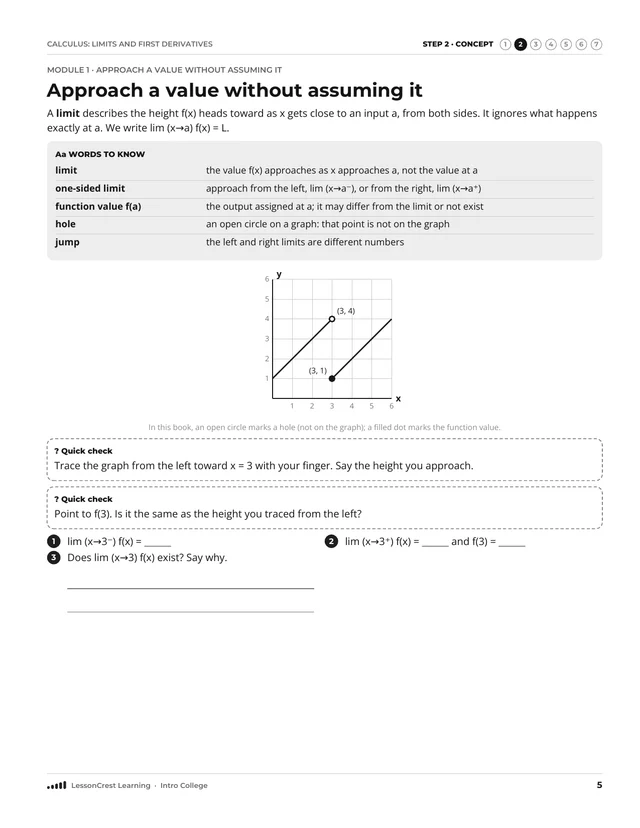
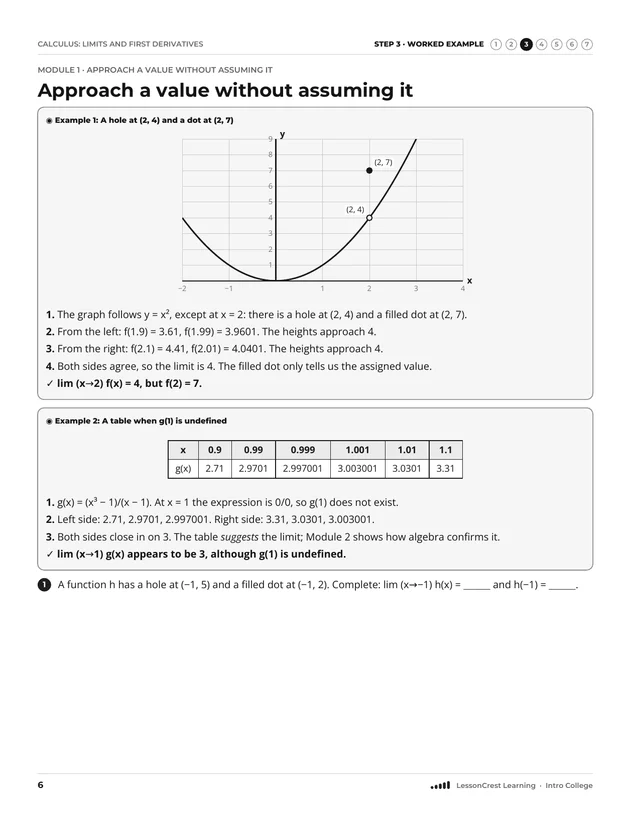
This workbook introduces the first two ideas of calculus: limits and derivatives. Learners read limits from tables and graphs, calculate them with factoring and conjugates, and test continuity. They then build the derivative from secant slopes, use the power, sum, product, quotient and chain rules, and write tangent lines. Every module follows the same sequence: explain, worked example, guided practice, independent practice, review and a checkpoint. Cumulative reviews, an exit check and a short retry follow. The answer key at the back explains each answer, names a common error and gives a reteaching cue.
For college learners who can factor, simplify rational expressions and read function graphs.
Covered
- In scope: finite limits of polynomial, rational and square-root expressions; one-sided limits; continuity of simple piecewise functions; the limit definition of the derivative; power, sum, constant-multiple, simple product, quotient and chain rules; tangent lines and linear estimates.
- Pages 53–54 then teach the quotient rule.
Not covered
Not in scope: ε–δ proofs, limits at infinity, derivatives of trigonometric, exponential and log functions, related rates, optimization and integrals.
Before you start
Before you start: you need the skills in College Algebra: Functions and Graphs and Quadratics: Patterns, Graphs, and Solutions.
Notice
Pictures in this book are simplified learning models. Check answers with the explanations at the back of the book.
Check the skills you need before you begin. If something feels tricky, an adult can help you start in the right place.
Read a short, clear explanation of the new idea and the words that go with it.
Watch the idea being used, one step at a time, in a worked example.
Practice with prompts and help cues. The help gets smaller as you get stronger.
Practice on your own with different kinds of questions, and explain your thinking.
Look back at earlier learning so it stays strong, then check where to go next.
Check your answers. Each answer explains why, names a common mistake, and shows how to fix it.
Tables, forms, methods, and models
Domains, composition, inverses, and models
Tables, slopes, equations and systems