Percentages in Everyday Problems
Parts, wholes, change, and claims
Know what your data can support, and say exactly that.
This workbook is a companion for an introductory college statistics course. It starts with study design: who a sample can describe, and when a study can support a claim about cause. Simulations then show how a statistic varies from sample to sample and what a standard error measures. Learners build and word confidence intervals, check method conditions, and read p-values without turning them into probabilities about hypotheses. Every module follows the same pattern: explain, worked example, guided and independent practice, review and a checkpoint. The answer key at the back gives each answer, its reasoning, a common error and a reteaching cue.
For intro college learners who can already describe distributions, find means and use basic probability.
Covered
In scope: random sampling and random assignment; simulated sampling distributions; standard error; 95% intervals for one proportion and one mean; tests by simulation and a one-sample z test; sample SD, z-scores and normal tables; p-values, Type I and II errors, and effect size.
Not covered
Not in scope: two-sample t formulas, chi-square tests, regression inference and Bayesian methods.
Before you start
Before you start, you need to describe distributions, find means, proportions and percents, use the 68–95–99.7 rule and find simple probabilities.
Things to have
Calculators are allowed.
Notice
Pictures in this book are simplified learning models. Check answers with the explanations at the back of the book.
Check the skills you need before you begin. If something feels tricky, an adult can help you start in the right place.
Read a short, clear explanation of the new idea and the words that go with it.
Watch the idea being used, one step at a time, in a worked example.
Practice with prompts and help cues. The help gets smaller as you get stronger.
Practice on your own with different kinds of questions, and explain your thinking.
Look back at earlier learning so it stays strong, then check where to go next.
Check your answers. Each answer explains why, names a common mistake, and shows how to fix it.
Parts, wholes, change, and claims
Displays, center, spread, and fair comparisons
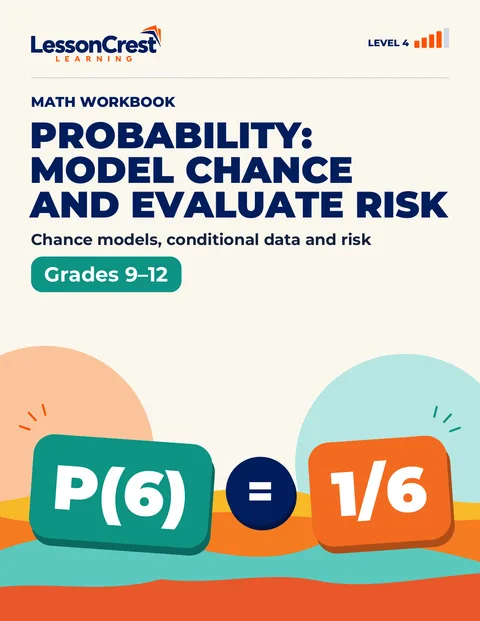
Chance models, conditional data and risk