Linear Equations and Graphs
Tables, slopes, equations and systems
Read every function closely: its inputs, its outputs, its restrictions.
This workbook gives introductory college learners focused practice with functions. It works through four connected skills: finding and justifying domains, transforming and composing functions, building inverses on a suitable domain, and comparing polynomial, rational, exponential and logarithmic models. Each module explains one idea plainly, shows worked examples, then fades support from guided to independent practice, error analysis and spaced review. An explanatory answer key names common errors and gives a reteaching cue for every page. It is a practice companion, not a full course.
For college and advanced high school learners who can graph lines and factor, solve and graph quadratics.
Covered
- Target skill. You will read functions across formulas, tables and graphs, justify domains, compose and invert functions, and compare polynomial, rational, exponential and logarithmic models.
- In scope: function notation, natural and context domains, interval notation, piecewise rules, transformations, completing the square, composition, inverses on restricted domains, intercepts, asymptotes and holes, rational equations, growth and decay rates, and basic exponential and logarithmic equations.
Not covered
Out of scope: trigonometric functions, systems, matrices, sequences, and formal limits.
Before you start
Before and after. You should already solve, factor and graph linear and quadratic equations (see Linear Equations and Graphs and Quadratics: Patterns, Graphs, and Solutions).
Things to have
Use a graphing tool to check, but decide domains from the algebra and the situation.
Notice
Pictures in this book are simplified learning models. Check answers with the explanations at the back of the book.
Check the skills you need before you begin. If something feels tricky, an adult can help you start in the right place.
Read a short, clear explanation of the new idea and the words that go with it.
Watch the idea being used, one step at a time, in a worked example.
Practice with prompts and help cues. The help gets smaller as you get stronger.
Practice on your own with different kinds of questions, and explain your thinking.
Look back at earlier learning so it stays strong, then check where to go next.
Check your answers. Each answer explains why, names a common mistake, and shows how to fix it.
Tables, slopes, equations and systems
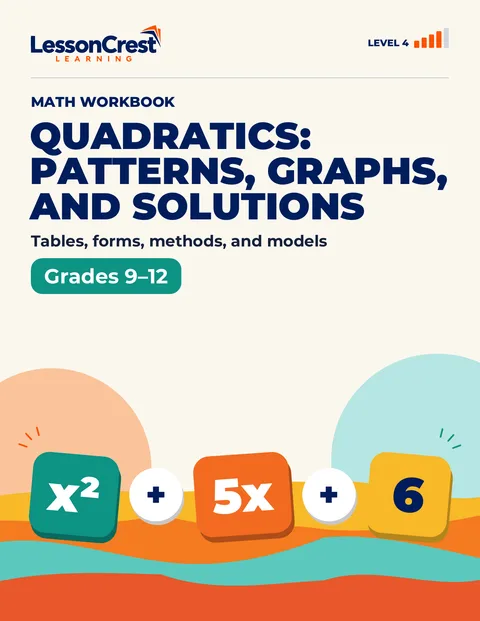
Tables, forms, methods, and models
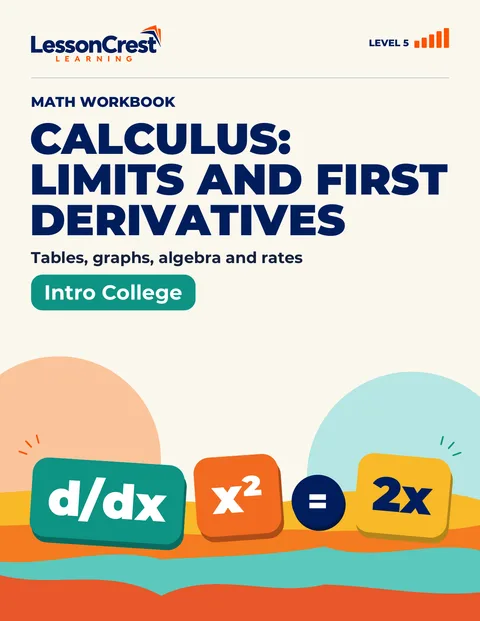
Tables, graphs, algebra and rates