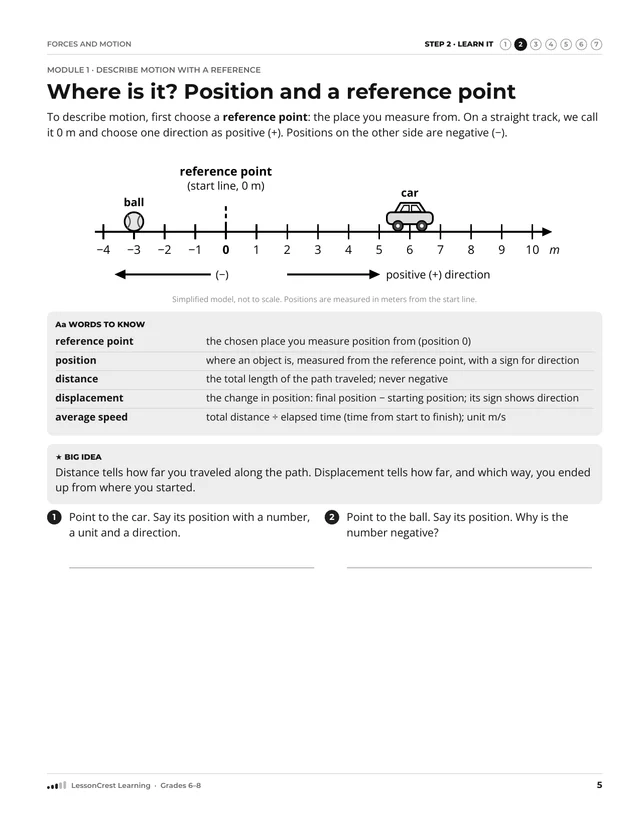
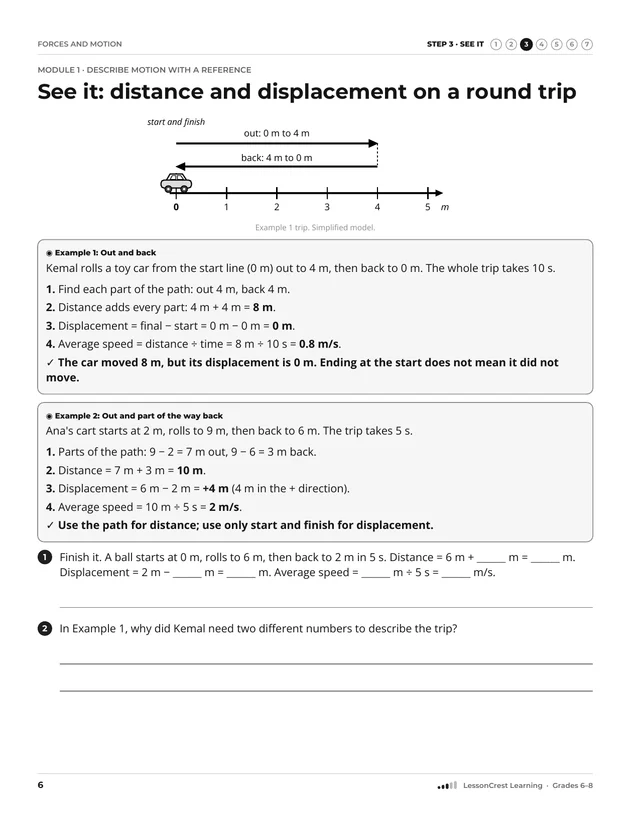
Physics
Free-Body Diagrams and Newton's Laws
Predict it. Diagram it. Explain it.
Why does a cart speed up, slow down or keep rolling? Learners describe motion from a reference point, read position–time graphs, draw labeled force diagrams and use net force and mass to predict acceleration. Every lesson follows the same seven LessonCrest steps, from a readiness check to explained answers.
With explained answers for every page
Covered
This book helps you describe motion from a reference point, read position–time graphs, draw force diagrams, and use net force and mass to predict how motion changes.
Not covered
- Everything moves along one straight line, and every force points left–right or up–down.
- Angled forces, momentum, energy and speed–time graph calculations come later, in the Physics: Free-Body Diagrams and Newton's Laws book.
Before you start, you should be able to
- Measure distance in meters and time in seconds
- Find a unit rate, such as meters per second
- Read a value from a graph's axes
- Tell an observation from a prediction
Things to have
Any activity in this book uses toy cars or carts on a clear floor; adults should check the space first.
Notices
This book teaches introductory physical science. Activities use only toy cars or carts rolled on a clear floor with adult approval.
Pictures in this book are simplified learning models. Check answers with the explanations at the back of the book.
Check the skills you need before you begin. If something feels tricky, an adult can help you start in the right place.
Read a short, clear explanation of the new idea and the words that go with it.
Watch the idea being used, one step at a time, in a worked example.
Practice with prompts and help cues. The help gets smaller as you get stronger.
Practice on your own with different kinds of questions, and explain your thinking.
Look back at earlier learning so it stays strong, then check where to go next.
Check your answers. Each answer explains why, names a common mistake, and shows how to fix it.
Free-Body Diagrams and Newton's Laws