About this book
Count atoms. Convert with moles. Predict what a reaction can make.
A step-by-step workbook for the calculations at the heart of high school chemistry. Learners balance equations with particle diagrams, convert between grams, moles and particles, use mole ratios, and find limiting reactants and percent yields, checking units, significant figures and conservation every time.
- Balance equations by changing coefficients, never formulas
- Convert grams, moles and particles with clear factor chains
- Use mole ratios, limiting reactants and percent yield
- Checkpoints, mixed reviews and exit checks
With explained answers for every page
Look inside
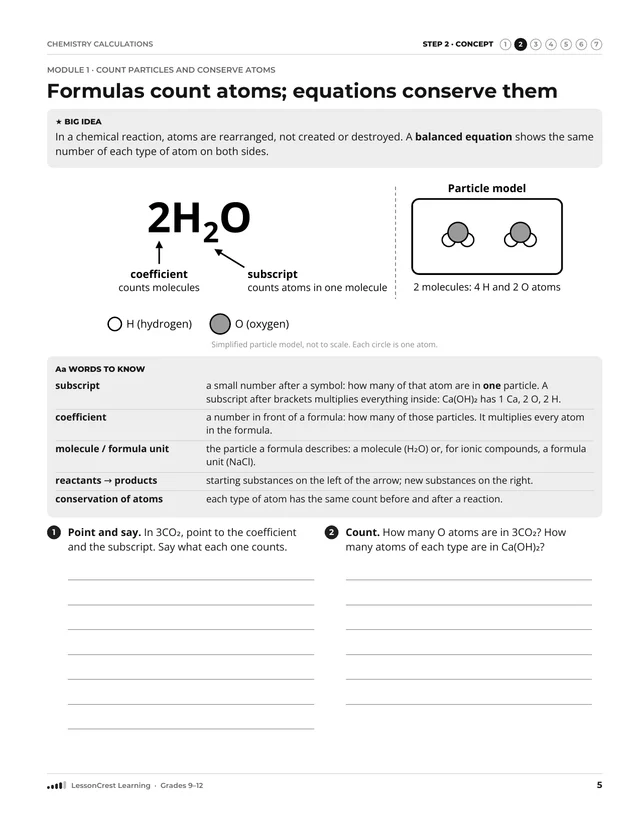
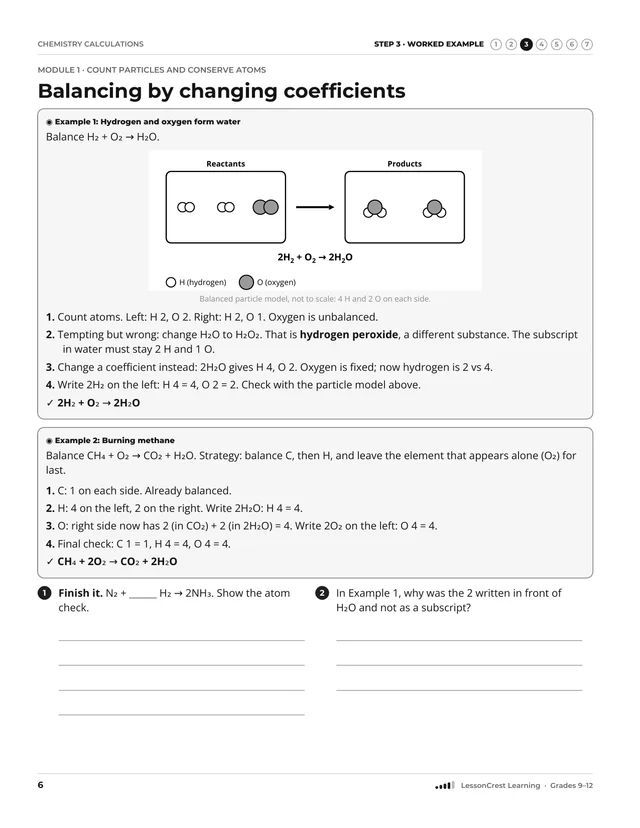
What this book covers
Covered
In scope: whole-number balancing by inspection and mass–mole–particle and reaction-ratio problems.
Not covered
- Out of scope: gas volumes, solution concentration and redox balancing.
- No page is a lab instruction.
Before you start, you should be able to
- I can multiply and divide numbers written in scientific notation.
- I can solve a simple proportion and rearrange an equation such as n = m ÷ M.
- I can read an element's symbol and atomic mass from a periodic table.
- I can tell an element from a compound.
Things to have
You need a pencil, a scientific calculator and the reference panel of atomic masses on page 3.
Notices
This book teaches chemistry calculations on paper. It contains no lab procedures; do not attempt any reaction described in it.
Pictures in this book are simplified learning models. Check answers with the explanations at the back of the book.
The steps in this book
- Step 1: Readiness Check
Check the skills you need before you begin. If something feels tricky, an adult can help you start in the right place.
- Step 2: Concept
Read a short, clear explanation of the new idea and the words that go with it.
- Step 3: Worked Example
Watch the idea being used, one step at a time, in a worked example.
- Step 4: Guided Practice
Practice with prompts and help cues. The help gets smaller as you get stronger.
- Step 5: Independent Practice
Practice on your own with different kinds of questions, and explain your thinking.
- Step 6: Review
Look back at earlier learning so it stays strong, then check where to go next.
- Step 7: Answers and Explanations
Check your answers. Each answer explains why, names a common mistake, and shows how to fix it.
What is in the book
The modules
- Module 1: Count particles and conserve atomsPages 5–14
- Module 2: The mole connects counting and massPages 15–24
- Module 3: Reaction coefficients give mole ratiosPages 25–34
- Module 4: Limits and plausible resultsPages 35–44
Contents
- Readiness check, pp. 3–4. Before Module 1. Its table tells you where to start.
- Modules, pp. 5–44
- Checkpoints, pp. 14, 24, 34, 44. The last page of each module.
- Mixed review, pp. 45–48. Questions from across the book, mixed together.
- Exit check, pp. 49–50. A last check across the book.
- Reflect and repair, p. 51
- Try again, p. 52. Fresh questions like those in the exit check.
- Extra practice, p. 53
- Answers and explanations, pp. 54–64. Notes in this part are headed “Why”, “Common mistake”, “Help” and “Look for”.