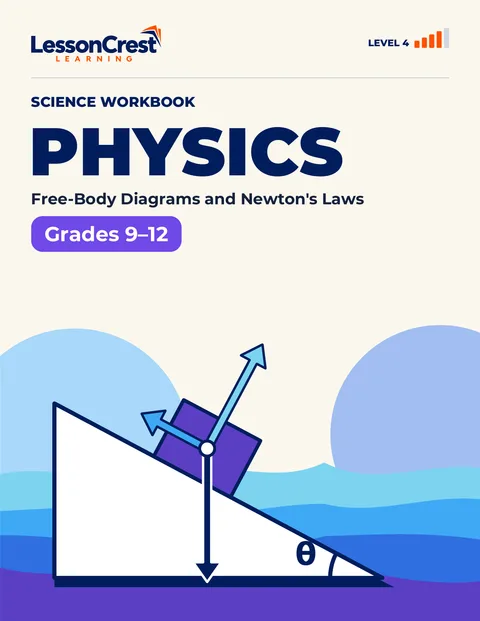
About this book
Draw the forces. Predict the motion.
A step-by-step workbook for high school physics. Learners choose a system, draw clear free-body diagrams, resolve forces into components, and use Newton’s laws to solve equilibrium, elevator, incline and friction problems, then check every answer with units, signs and limiting cases.
- Free-body diagrams with every force labeled by type and agent
- Newton’s three laws, ΣF = ma, and third-law pairs
- Inclines, components, and static and kinetic friction
- A full problem-solving routine with built-in checks
With explained answers for every page
Look inside
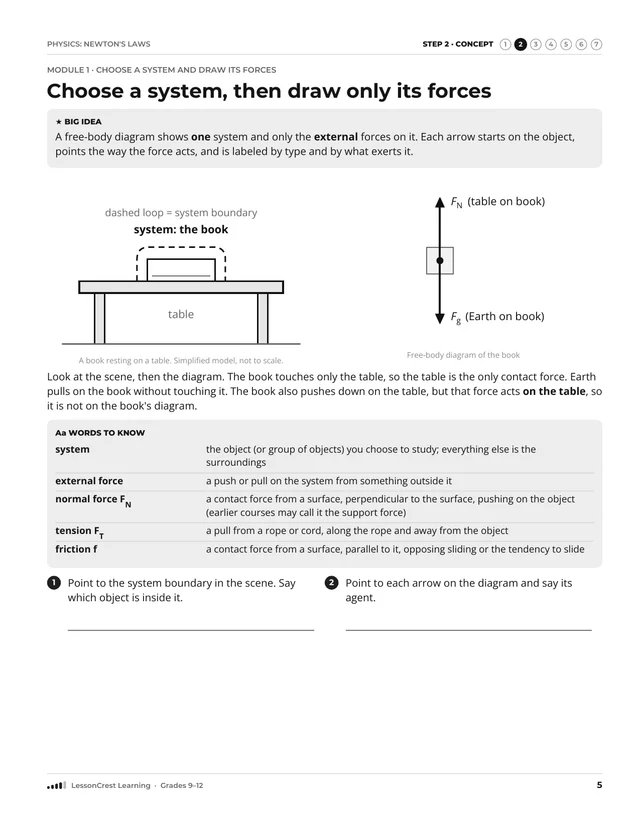
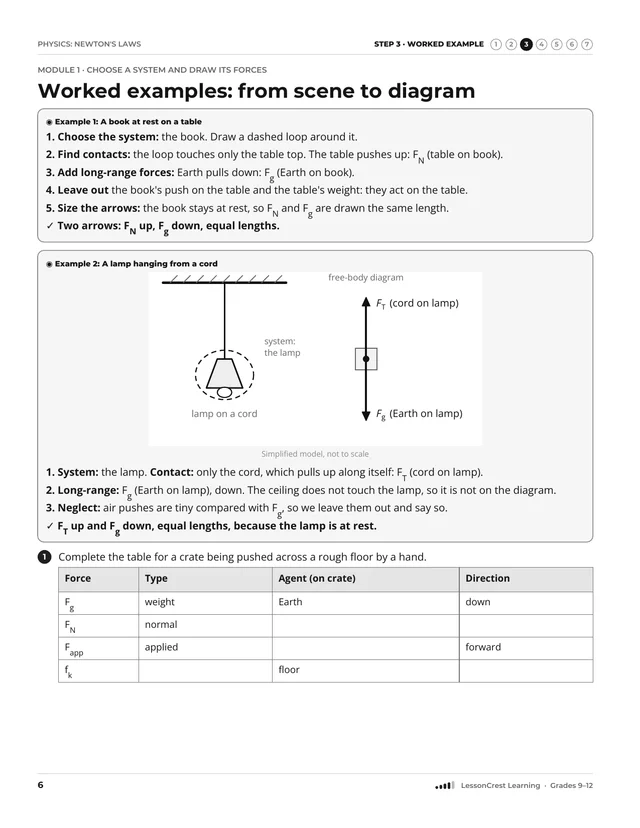
What this book covers
Covered
- This workbook teaches you to build a force model and use it.
- You will choose a system, draw its free-body diagram, resolve forces into components, and apply Newton's laws to equilibrium and acceleration problems, including elevators, inclines, friction and angled pulls.
Not covered
Circular motion, momentum, energy, torque, springs and air drag that changes with speed are left for later courses.
Before you start, you should be able to
- I can calculate acceleration from a change in velocity.
- I can split a vector into horizontal and vertical components.
- I can solve a one-step or two-step linear equation.
- I can use sin, cos and tan in a right triangle.
Notices
This book teaches introductory mechanics with simplified models. Any demonstration it suggests uses low-risk classroom items; follow your teacher's safety rules.
Pictures in this book are simplified learning models. Check answers with the explanations at the back of the book.
The steps in this book
- Step 1: Readiness Check
Check the skills you need before you begin. If something feels tricky, an adult can help you start in the right place.
- Step 2: Concept
Read a short, clear explanation of the new idea and the words that go with it.
- Step 3: Worked Example
Watch the idea being used, one step at a time, in a worked example.
- Step 4: Guided Practice
Practice with prompts and help cues. The help gets smaller as you get stronger.
- Step 5: Independent Practice
Practice on your own with different kinds of questions, and explain your thinking.
- Step 6: Review
Look back at earlier learning so it stays strong, then check where to go next.
- Step 7: Answers and Explanations
Check your answers. Each answer explains why, names a common mistake, and shows how to fix it.
What is in the book
The modules
- Module 1: Choose a system and draw its forcesPages 5–14
- Module 2: Newton's laws connect force and motionPages 15–24
- Module 3: Components, inclines, and frictionPages 25–34
- Module 4: Solve and test a complete modelPages 35–44
Contents
- Readiness check, pp. 3–4. Before Module 1. Its table tells you where to start.
- Modules, pp. 5–44
- Checkpoints, pp. 14, 24, 34, 44. The last page of each module.
- Mixed review, pp. 45–48. Questions from across the book, mixed together.
- Exit check, pp. 49–50. A last check across the book.
- Reflect and repair, p. 51
- Try again, p. 52. Fresh questions like those in the exit check.
- Extra practice, pp. 53–54
- Answers and explanations, pp. 55–64. Notes in this part are headed “Why”, “Common mistake”, “Help” and “Look for”.