About this book
From DNA to probability, and where simple models stop.
Connect DNA, chromosomes, genes and alleles. Follow alleles through meiosis, build Punnett squares, and work out probabilities step by step. Then test simple models against real complexity: incomplete dominance, codominance, multiple alleles, sex-linked genes, pedigrees and polygenic traits, using peas, fruit flies, cats and flowers.
- Model how alleles separate into gametes
- Calculate and check genotype and phenotype probabilities
- Compare inheritance models against evidence
- Explain why one gene rarely tells the whole story
With explained answers for every page
Look inside
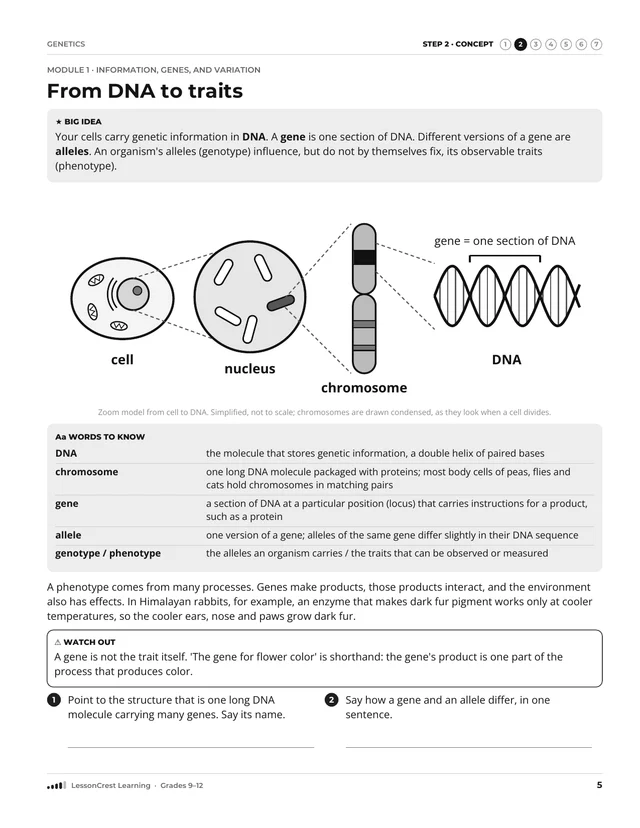
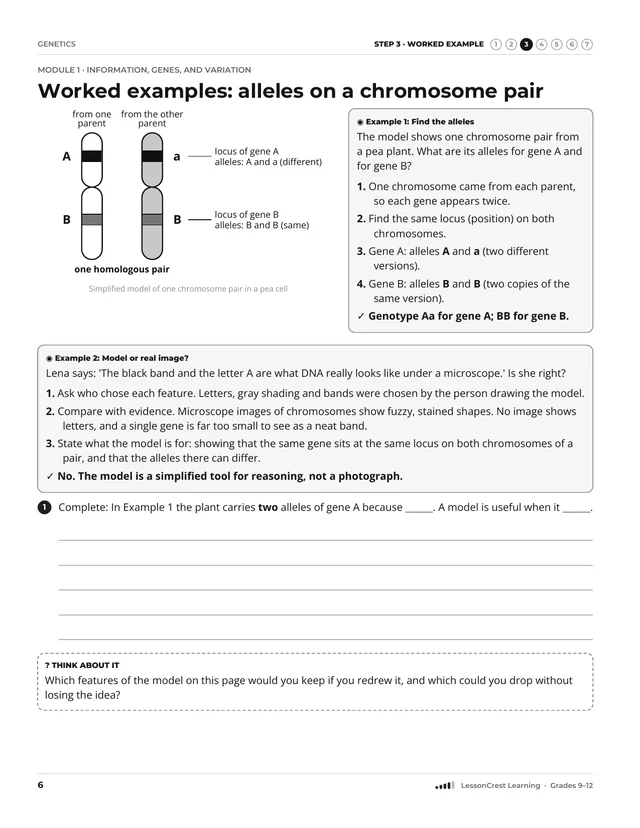
What this book covers
Covered
In scope: one-gene and two-gene crosses, probability rules, incomplete dominance, codominance, multiple alleles, sex-linked genes, pedigrees and polygenic traits at an introductory level.
Not covered
Out of scope: DNA sequencing, gene expression in detail, lab work, statistics tests, and any prediction about a real person's health or traits.
Before you start, you should be able to
- Describe a cell and its nucleus at an introductory level
- List outcomes of simple chance events and write probabilities as fractions
- Read a simple diagram or table
- Tell an observation apart from an explanation
Notices
This book teaches inheritance models with plant and animal examples. It does not predict any person's traits or give medical advice.
Pictures in this book are simplified learning models. Check answers with the explanations at the back of the book.
The steps in this book
- Step 1: Readiness Check
Check the skills you need before you begin. If something feels tricky, an adult can help you start in the right place.
- Step 2: Concept
Read a short, clear explanation of the new idea and the words that go with it.
- Step 3: Worked Example
Watch the idea being used, one step at a time, in a worked example.
- Step 4: Guided Practice
Practice with prompts and help cues. The help gets smaller as you get stronger.
- Step 5: Independent Practice
Practice on your own with different kinds of questions, and explain your thinking.
- Step 6: Review
Look back at earlier learning so it stays strong, then check where to go next.
- Step 7: Answers and Explanations
Check your answers. Each answer explains why, names a common mistake, and shows how to fix it.
What is in the book
The modules
- Module 1: Information, genes, and variationPages 5–14
- Module 2: Alleles separate into gametesPages 15–24
- Module 3: Punnett squares model probabilitiesPages 25–34
- Module 4: Test models against complexityPages 35–44
Contents
- Readiness check, pp. 3–4. Before Module 1. Its table tells you where to start.
- Modules, pp. 5–44
- Checkpoints, pp. 14, 24, 34, 44. The last page of each module.
- Mixed review, pp. 45–48. Questions from across the book, mixed together.
- Exit check, pp. 49–50. A last check across the book.
- Reflect and repair, p. 51
- Try again, p. 52. Fresh questions like those in the exit check.
- Extra practice, p. 53
- Answers and explanations, pp. 54–64. Notes in this part are headed “Why”, “Common mistake”, “Help” and “Look for”.