Money skills workbook
Personal Finance: Credit, Interest, and Borrowing Costs: Compare Borrowing Offers by Total Cost
Grades 9–12Level 4
About this book
Compare the total cost, not just the monthly payment.
Teens read fictional borrowing offers, calculate simple and compound interest, follow repayment schedules, and compare loans by total cost, fees and risk. Education about how credit works, not personal credit advice.
- Read APR, principal, term and fees
- Calculate interest and payment schedules
- Compare offers by total cost and spot what is missing
Fictional offers with fully worked answers
Look inside
What this book covers
Covered
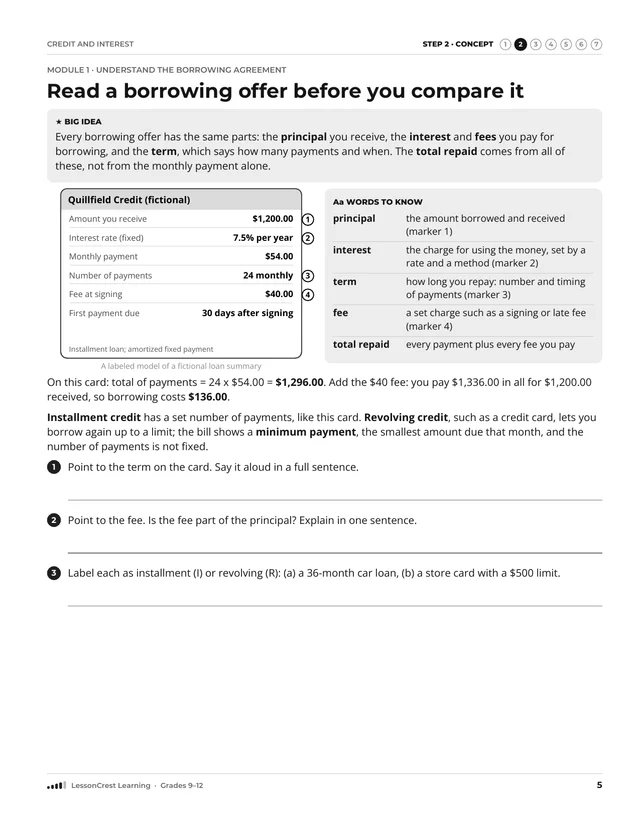
Covered: principal, fees, term, simple interest, compounding, repayment schedules, APR as a disclosure, total cost and uncertainty.
Not covered
Not covered: credit scores, taxes, investing, legal rights in detail, or any one real product.
Before you start, you should be able to
- Find a percent of an amount
- Multiply and add money in dollars and cents
- Read a simple payment schedule
- Tell the amount borrowed apart from an added charge
Things to have
- A pencil and a basic calculator.
- Optional: a ruler for tables. A reader may read text aloud and a scribe may write answers; note any help given.
Notice
This book is for education only. It is not personal credit or financial advice. All lenders, offers, stores and people are fictional, amounts are in U.S. dollars, and every problem states its interest method and assumptions. Facts about U.S. rules are given "as of 2026, United States" and kept general; rules change and vary by product.
Notice
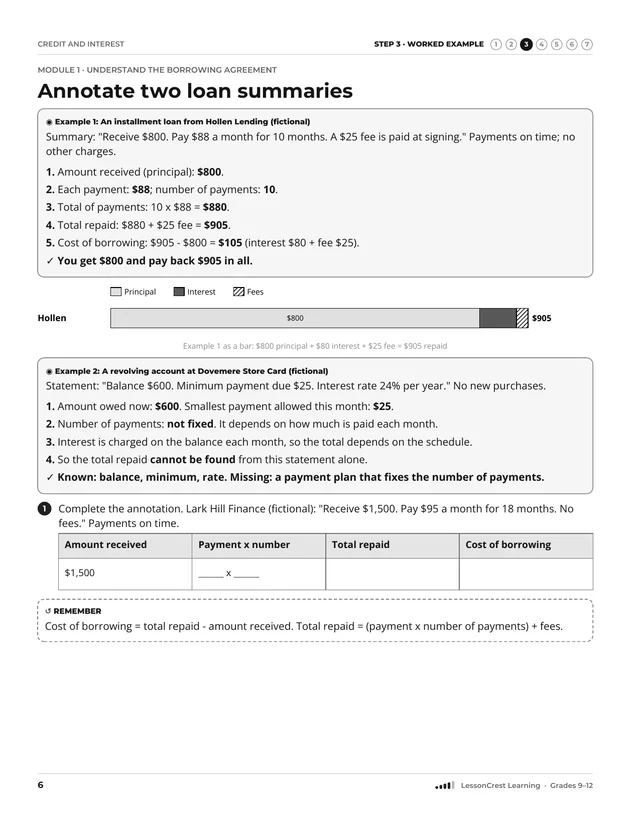
Pictures in this book are simplified learning models. Check answers with the explanations at the back of the book.
The steps in this book
- Step 1: Readiness Check
Check the skills you need before you begin. If something feels tricky, an adult can help you start in the right place.
- Step 2: Concept
Read a short, clear explanation of the new idea and the words that go with it.
- Step 3: Worked Example
Watch the idea being used, one step at a time, in a worked example.
- Step 4: Guided Practice
Practice with prompts and help cues. The help gets smaller as you get stronger.
- Step 5: Independent Practice
Practice on your own with different kinds of questions, and explain your thinking.
- Step 6: Review
Look back at earlier learning so it stays strong, then check where to go next.
- Step 7: Answers and Explanations
Check your answers. Each answer explains why, names a common mistake, and shows how to fix it.
What is in the book
The modules
- Module 1: Understand the borrowing agreementPages 5–14
- Module 2: Interest depends on rate and timingPages 15–24
- Module 3: Repayment changes the balancePages 25–34
- Module 4: Compare cost, uncertainty, and constraintsPages 35–44
Contents
- Readiness check, pp. 3–4. Before Module 1. Its table tells you where to start.
- Modules, pp. 5–44
- Checkpoints, pp. 14, 24, 34, 44. The last page of each module.
- Mixed review, pp. 45–48. Questions from across the book, mixed together.
- Exit check, pp. 49–50. A last check across the book.
- Reflect and repair, p. 51
- Try again, p. 52. Fresh questions like those in the exit check.
- Extra practice, p. 53
- Answers and explanations, pp. 54–64. Notes in this part are headed “Why”, “Common mistake”, “Help” and “Look for”.