About this book
Edit for the reader, not the rulebook
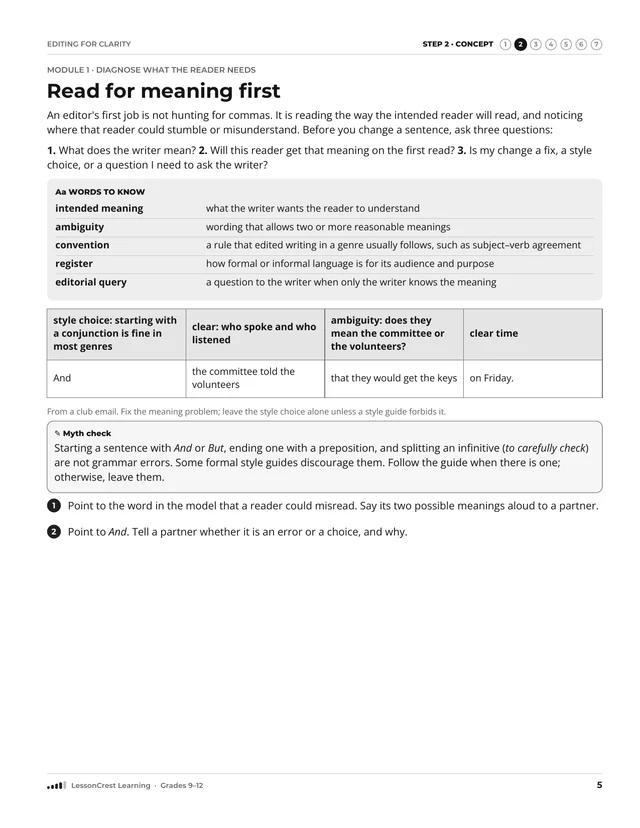
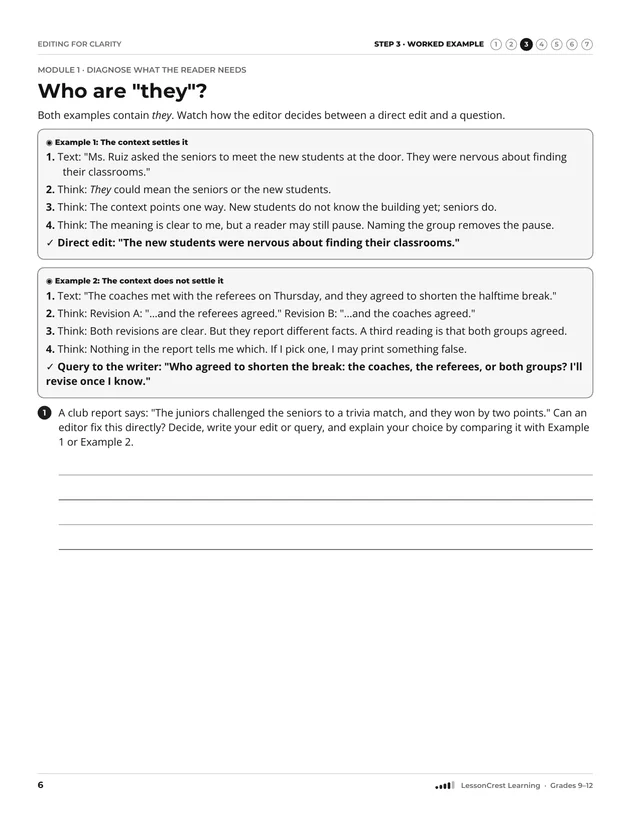
This workbook teaches high school writers to edit sentences in context. Most tasks sit inside a short original passage: an essay, a lab report, an email, a set of instructions. Four modules cover diagnosing what a reader needs, agreement and reference, modifiers and emphasis, and paragraph flow. Each edit comes with a reason, and the book shows when a so-called rule, such as never starting a sentence with “And” or never splitting an infinitive, is really a style choice. Learners also practice asking the writer when the meaning is genuinely unclear. The answer key explains each answer and lists acceptable alternative edits.
- Readiness check with routes to the right starting point
- Worked examples that show the editor’s thinking
- Guided, independent and mixed review practice
- Exit checks, a reflection page and a second try
- Explanatory key with common errors and reteach pages
With explained answers for every page
Look inside
What this book covers
Covered
- This book teaches you to edit sentences so a reader gets the meaning the writer intended.
- You will fix unclear references, agreement and tense, misplaced modifiers, weak emphasis and choppy flow.
Notice
Pictures in this book are simplified learning models. Check answers with the explanations at the back of the book.
The steps in this book
- Step 1: Readiness Check
Check the skills you need before you begin. If something feels tricky, an adult can help you start in the right place.
- Step 2: Concept
Read a short, clear explanation of the new idea and the words that go with it.
- Step 3: Worked Example
Watch the idea being used, one step at a time, in a worked example.
- Step 4: Guided Practice
Practice with prompts and help cues. The help gets smaller as you get stronger.
- Step 5: Independent Practice
Practice on your own with different kinds of questions, and explain your thinking.
- Step 6: Review
Look back at earlier learning so it stays strong, then check where to go next.
- Step 7: Answers and Explanations
Check your answers. Each answer explains why, names a common mistake, and shows how to fix it.
What is in the book
The modules
- Module 1: Diagnose what the reader needsPages 5–14
- Module 2: Control agreement and referencePages 15–24
- Module 3: Place modifiers and shape emphasisPages 25–34
- Module 4: Make paragraphs flow and verify editsPages 35–44
Contents
- Readiness check, pp. 3–4. Before Module 1. Its table tells you where to start.
- Modules, pp. 5–44
- Checkpoints, pp. 14, 24, 34, 44. The last page of each module.
- Mixed review, pp. 45–48. Questions from across the book, mixed together.
- Exit check, pp. 49–50. A last check across the book.
- Reflect and repair, p. 51
- Try again, p. 52. Fresh questions like those in the exit check.
- Extra practice, p. 53
- Answers and explanations, pp. 54–64. Notes in this part are headed “Why”, “Common mistake” and “Help”.