Ratios and Unit Rates
Tables, diagrams, and fair comparisons
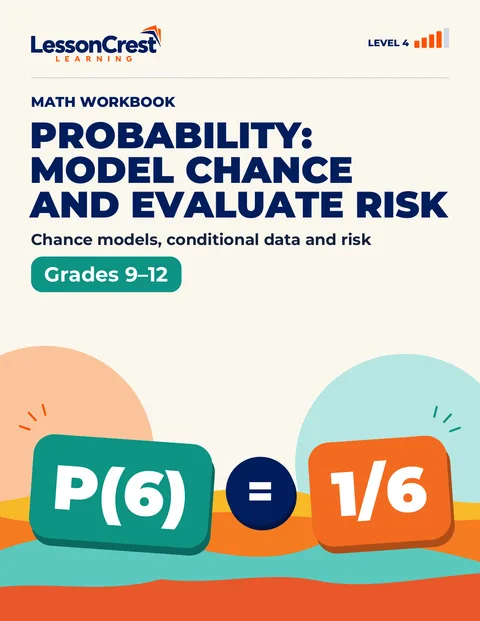
Count carefully, check the condition, then judge the claim.
This workbook helps learners in grades 9–12 build chance models and read risk claims with care. Four modules move from model versus observed frequency, to trees and tables for combined events, to conditional probability and base rates, to expected value and responsible claims. A readiness check comes first. Each module then gives a plain explanation, worked examples, guided practice, independent practice, spaced review and a checkpoint. All data and stories are fictional. An explanatory answer key at the back gives each answer, why it works, a common error and a reteaching cue.
For learners in grades 9–12 who can already work with fractions, percents, ratios and simple tables.
Covered
In scope: sample spaces, relative frequency, simulation, complements, the addition rule, independent and dependent events, two-way tables, base rates, expected value, and absolute versus relative change, plus counting codes and mutually exclusive versus independent events.
Not covered
Not in scope: counting formulas for arrangements, binomial and normal distributions, and formal inference.
Before you start
Before you start, you should be comfortable with fractions, percents and ratios.
Things to have
Access: a calculator is fine.
Notice
Every data set and story is fictional. Nothing here is financial, medical or legal advice.
Notice
Pictures in this book are simplified learning models. Check answers with the explanations at the back of the book.
Check the skills you need before you begin. If something feels tricky, an adult can help you start in the right place.
Read a short, clear explanation of the new idea and the words that go with it.
Watch the idea being used, one step at a time, in a worked example.
Practice with prompts and help cues. The help gets smaller as you get stronger.
Practice on your own with different kinds of questions, and explain your thinking.
Look back at earlier learning so it stays strong, then check where to go next.
Check your answers. Each answer explains why, names a common mistake, and shows how to fix it.
Tables, diagrams, and fair comparisons
Parts, wholes, change, and claims
Displays, center, spread, and fair comparisons
Study design, sampling variation, intervals and tests