About this book
Research you can stand behind
This workbook takes high school students through the skills of a short research project, one step at a time. Learners narrow a broad topic into an answerable question, judge sources for a stated purpose, keep a source trail, and tell quotation, paraphrase, summary, and plagiarism apart. Citation examples follow MLA style, 9th edition. The final module turns source notes into a qualified argument that deals honestly with counterevidence. The book follows seven steps, from a readiness check through explanations, worked examples, practice, and reviews to an answer key that explains why answers work and how to fix common mistakes. All sources in the book are invented for practice.
- Readiness check with a starting route
- Four modules with explanations, worked examples, and guided and independent practice
- Cumulative reviews, two exit checks, a retry page, and extra practice
- Answer key with reasons, common mistakes, and pages to revisit
- Invented practice sources, so the focus stays on skills
With explained answers for every page
Look inside
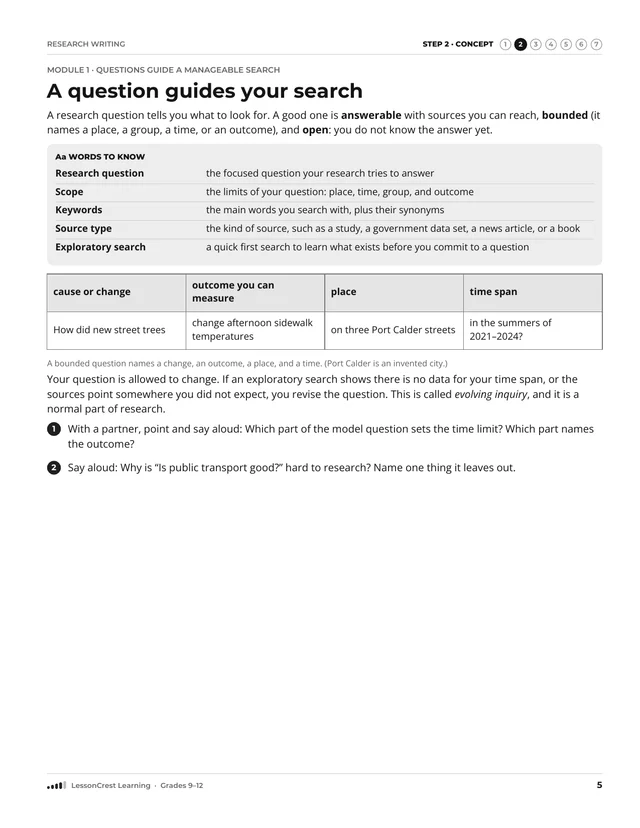
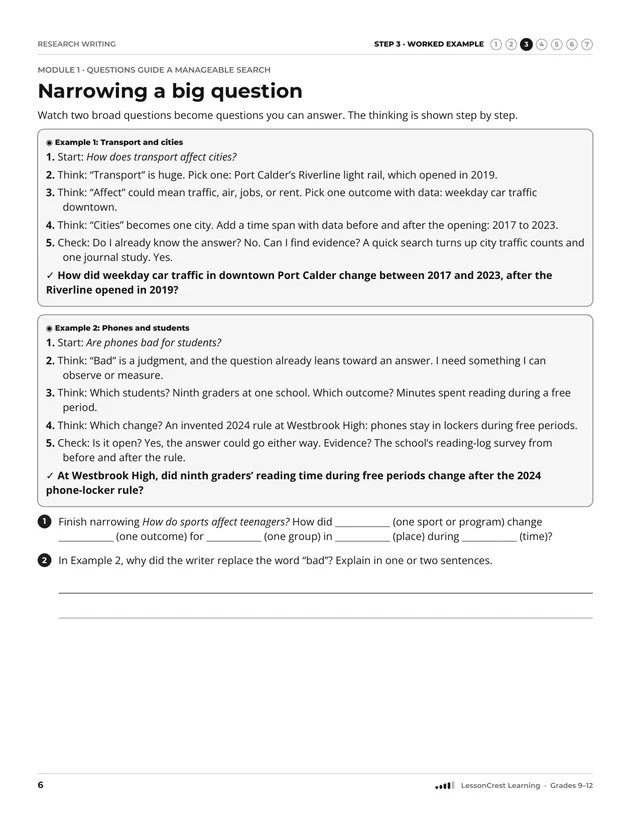
What this book covers
Covered
Covered: research questions and search plans; evaluating sources; quotation, paraphrase, summary, and plagiarism; in-text citations and Works Cited entries; drafting and revising a short research argument.
Not covered
Not covered: full-length papers, database-specific search tools, and other citation styles.
Notice
Check answers with the explanations at the back of the book.
The steps in this book
- Step 1: Readiness Check
Check the skills you need before you begin. If something feels tricky, an adult can help you start in the right place.
- Step 2: Concept
Read a short, clear explanation of the new idea and the words that go with it.
- Step 3: Worked Example
Watch the idea being used, one step at a time, in a worked example.
- Step 4: Guided Practice
Practice with prompts and help cues. The help gets smaller as you get stronger.
- Step 5: Independent Practice
Practice on your own with different kinds of questions, and explain your thinking.
- Step 6: Review
Look back at earlier learning so it stays strong, then check where to go next.
- Step 7: Answers and Explanations
Check your answers. Each answer explains why, names a common mistake, and shows how to fix it.
What is in the book
The modules
- Module 1: Questions guide a manageable searchPages 5–14
- Module 2: Evaluate sources and keep a trailPages 15–24
- Module 3: Integrate evidence with attributionPages 25–34
- Module 4: Draft an argument the sources supportPages 35–44
Contents
- Readiness check, pp. 3–4. Before Module 1. Its table tells you where to start.
- Modules, pp. 5–44
- Checkpoints, pp. 14, 24, 34, 44. The last page of each module.
- Mixed review, pp. 45–48. Questions from across the book, mixed together.
- Exit check, pp. 49–50. A last check across the book.
- Reflect and repair, p. 51
- Try again, p. 52. Fresh questions like those in the exit check.
- Extra practice, p. 53
- Answers and explanations, pp. 54–64. Notes in this part are headed “Why”, “Common mistake” and “Help”.