Expressions and One-Variable Equations
Variables, equivalence, and balance
State what you know, cite why it is true, then conclude.
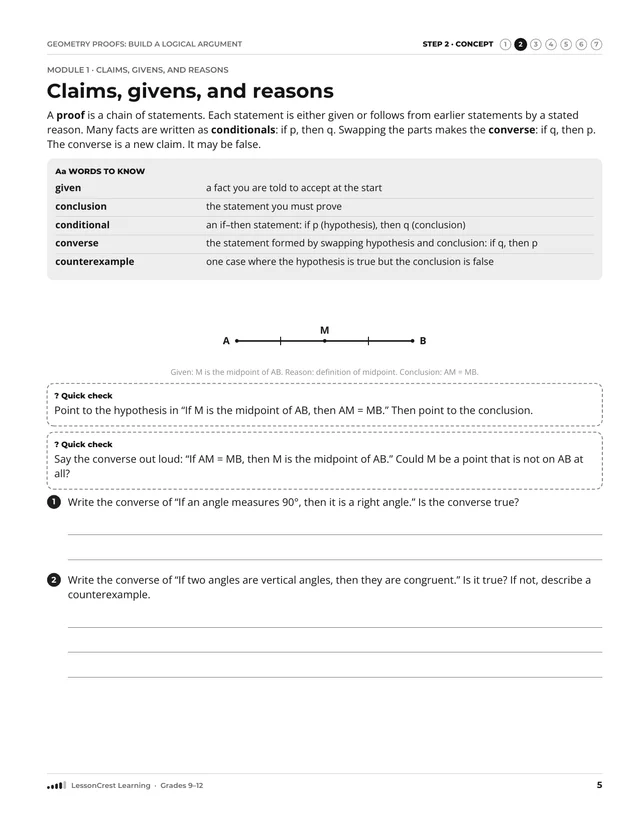
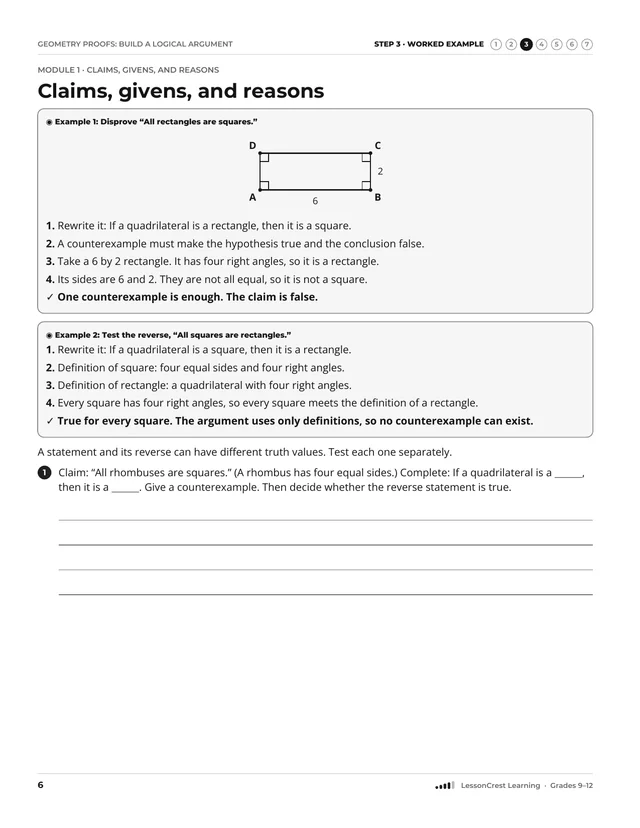
A proof is a chain of statements, and every link needs a reason. This workbook helps learners in grades 9–12 build that chain one step at a time. It starts with givens, conditionals, converses, and counterexamples. It then uses vertical angles and parallel lines to build short angle proofs. Learners prove triangles congruent with SSS, SAS, ASA, AAS, and HL, then use AA similarity to find unknown lengths. Error-analysis pages show common mistakes, such as assuming lines are parallel or reasoning in a circle. An explanatory answer key helps adults check reasoning, not only final answers.
For grades 9–12 learners who know angle facts, the Pythagorean theorem, and linear equations.
Covered
- In this book: givens, conclusions, conditionals, converses, and counterexamples (pp. 5–14); angle proofs with vertical angles and parallel lines (pp. 15–24); triangle congruence with SSS, SAS, ASA, AAS, and HL (pp. 25–34); AA similarity, side ratios, and proof revision (pp. 35–44).
- Added pages prove three theorems: vertical angles, triangle angle sum, and perpendicular bisector (pp. 53–55).
Not covered
- Not in this book: circle theorems, coordinate proofs, constructions, and trigonometry.
- The Pythagorean theorem is used as a known fact.
Before you start
If equations feel shaky, first use Expressions and One-Variable Equations.
Notice
Pictures in this book are simplified learning models. Check answers with the explanations at the back of the book.
Check the skills you need before you begin. If something feels tricky, an adult can help you start in the right place.
Read a short, clear explanation of the new idea and the words that go with it.
Watch the idea being used, one step at a time, in a worked example.
Practice with prompts and help cues. The help gets smaller as you get stronger.
Practice on your own with different kinds of questions, and explain your thinking.
Look back at earlier learning so it stays strong, then check where to go next.
Check your answers. Each answer explains why, names a common mistake, and shows how to fix it.
Variables, equivalence, and balance
Sine, cosine, tangent and indirect measurement