History through Primary Sources: Sourcing, Context, and Corroboration
About this book
Read the sources. Weigh the evidence. Make a careful claim.
What happened on King Street, Boston, on the night of March 5, 1770? Eyewitnesses, newspapers, a captain, a lawyer and an engraver all told different stories. This workbook uses short, verified excerpts from those public-domain sources to practice the moves historians use: sourcing, reading in context, corroborating, and writing a claim that is as confident as the evidence allows.
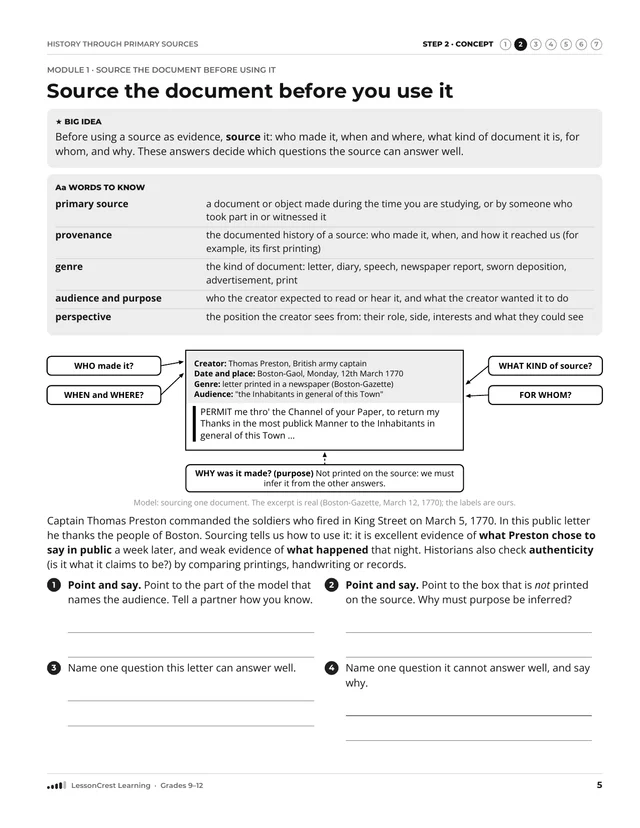
- Source a document: creator, date, genre, audience, purpose
- Read period language in context without excusing harm
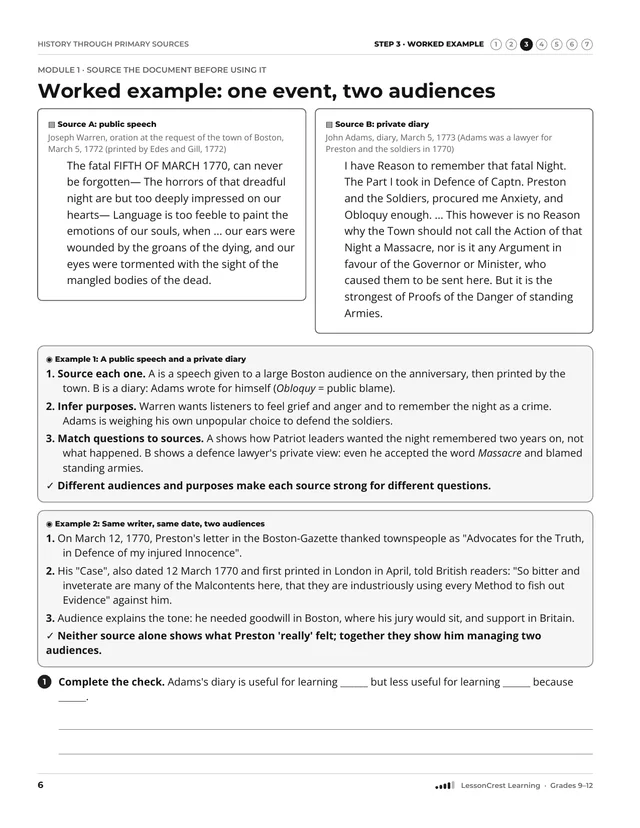
- Compare conflicting accounts and spot sources that are not independent
- Write a short argument with citations, counterevidence and limits
With explained answers for every page
Look inside
What this book covers
Covered
Scope. All sources come from one bounded event, the shooting in King Street, Boston, on March 5, 1770 (the Boston Massacre), and the months around it, plus two short fictional exhibit tasks that are labelled as fictional.
Not covered
The book teaches how to use evidence; it is not a full history of the American Revolution and does not cover archive research, detailed citation styles, or analysis of the original prints (images are described in words, not reproduced).
Before you start, you should be able to
- Read a short informational text and find its main point
- Put dated events in order on a timeline
- Tell a quotation from a paraphrase
- Find the creator and date of a document
Notices
Historical excerpts are quoted from public-domain sources (1770-1773) with their original spelling; each excerpt is cited beside it. Some sources use harsh or biased language; context notes explain it.
Pictures in this book are simplified learning models. Check answers with the explanations at the back of the book.
The steps in this book
- Step 1: Readiness Check
Check the reading and timeline skills you need before you start.
- Step 2: Concept
Learn one historical thinking move, its key terms and a labelled model.
- Step 3: Worked Example
Follow two worked examples that show every reasoning step.
- Step 4: Guided Practice
Try it with prompts and Help boxes, then with less help.
- Step 5: Independent Practice
Work alone on varied tasks, a new situation and a common mistake.
- Step 6: Review
Retrieve earlier skills, then use the checkpoint to choose what to practice next.
- Step 7: Answers and Explanations
Compare with explained answers, common mistakes and reteaching routes.
What is in the book
The modules
- Module 1: Source the document before using itPages 5–14
- Module 2: Read details in historical contextPages 15–24
- Module 3: Corroborate and explain disagreementPages 25–34
- Module 4: Build a qualified interpretationPages 35–44
Contents
- Readiness check, pp. 3–4. Before Module 1. Its table tells you where to start.
- Modules, pp. 5–44
- Checkpoints, pp. 14, 24, 34, 44. The last page of each module.
- Mixed review, pp. 45–48. Questions from across the book, mixed together.
- Exit check, pp. 49–50. A last check across the book.
- Reflect and repair, p. 51
- Try again, p. 52. Fresh questions like those in the exit check.
- Extra practice, pp. 53–56
- Answers and explanations, pp. 57–64. Notes in this part are headed “Why”, “Common mistake”, “Help” and “Look for”.