About this book
Ask it. Measure it. Graph it. Explain it.
Turn curious questions into real investigations. Learners define variables they can measure, record trustworthy data, choose and draw honest graphs, and write conclusions that cite evidence and admit limits. Every lesson follows the same seven LessonCrest steps, from a readiness check to explained answers.
- Write testable questions with clear variables
- Build data tables, find means and flag odd readings
- Draw bar, line and scatter graphs with honest scales
- Write claim–evidence–reasoning conclusions with limits
With explained answers for every page
Look inside
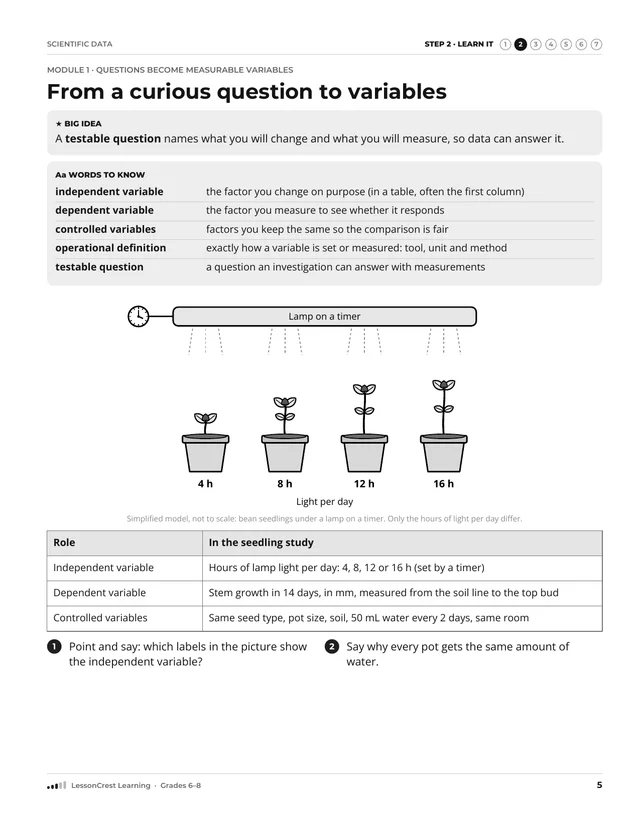
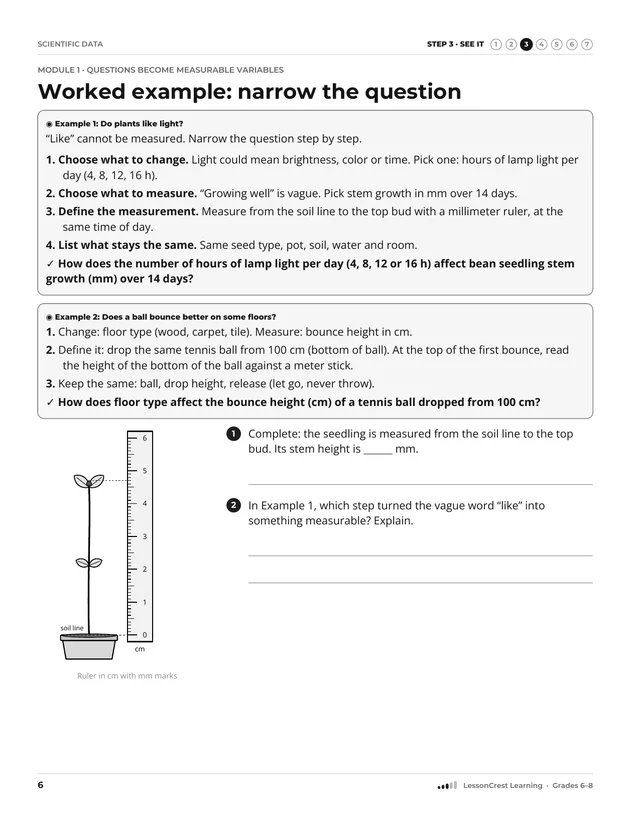
What this book covers
Covered
This book teaches four skills in order: turning a question into variables you can measure, recording trustworthy data, drawing honest graphs, and writing conclusions with evidence and limits.
Not covered
The book does not cover lab safety training, advanced statistics or how to run hazardous experiments.
Before you start, you should be able to
- Name a quantity and its unit in a table
- Find the mean (average) of a few numbers
- Describe what you observe without explaining why
- Find and plot a point on a pair of axes
Notices
All data sets in this book are invented for practice. Suggested activities use safe, everyday materials; warm (not hot) water is handled by an adult.
Pictures in this book are simplified learning models. Check answers with the explanations at the back of the book.
The steps in this book
- Step 1: Get Ready
Check the skills you need before you begin. If something feels tricky, an adult can help you start in the right place.
- Step 2: Learn It
Read a short, clear explanation of the new idea and the words that go with it.
- Step 3: See It
Watch the idea being used, one step at a time, in a worked example.
- Step 4: Try It Together
Practice with prompts and help cues. The help gets smaller as you get stronger.
- Step 5: On Your Own
Practice on your own with different kinds of questions, and explain your thinking.
- Step 6: Look Back
Look back at earlier learning so it stays strong, then check where to go next.
- Step 7: Check and Fix
Check your answers. Each answer explains why, names a common mistake, and shows how to fix it.
What is in the book
The modules
- Module 1: Questions become measurable variablesPages 5–14
- Module 2: Collect and organize trustworthy dataPages 15–24
- Module 3: Graphs reveal and can distort patternsPages 25–34
- Module 4: Conclusions with evidence and limitsPages 35–44
Contents
- Readiness check, pp. 3–4. Before Module 1. Its table tells you where to start.
- Modules, pp. 5–44
- Checkpoints, pp. 14, 24, 34, 44. The last page of each module.
- Mixed review, pp. 45–48. Questions from across the book, mixed together.
- Exit check, pp. 49–50. A last check across the book.
- Reflect and repair, p. 51
- Try again, p. 52. Fresh questions like those in the exit check.
- Extra practice, p. 53
- Answers and explanations, pp. 54–64. Notes in this part are headed “Why”, “Common mistake”, “Help” and “Look for”.