About this book
Follow a decision from idea to action.
Who decides about a pothole, a park curfew or a new national law? This grades 6–8 workbook shows how federal, state, local and tribal governments share power, how the three federal branches check one another, and how bills, regulations, court decisions and local ordinances come to be. Learners practice checking civic claims against official sources and explore lawful ways to take part, without being told what to think.
- Federalism, jurisdiction and tribal sovereignty
- The three branches, checks and balances
- How bills and local ordinances move, step by step
- Checking claims and drafting a mock public comment
With explained answers for every page
Look inside
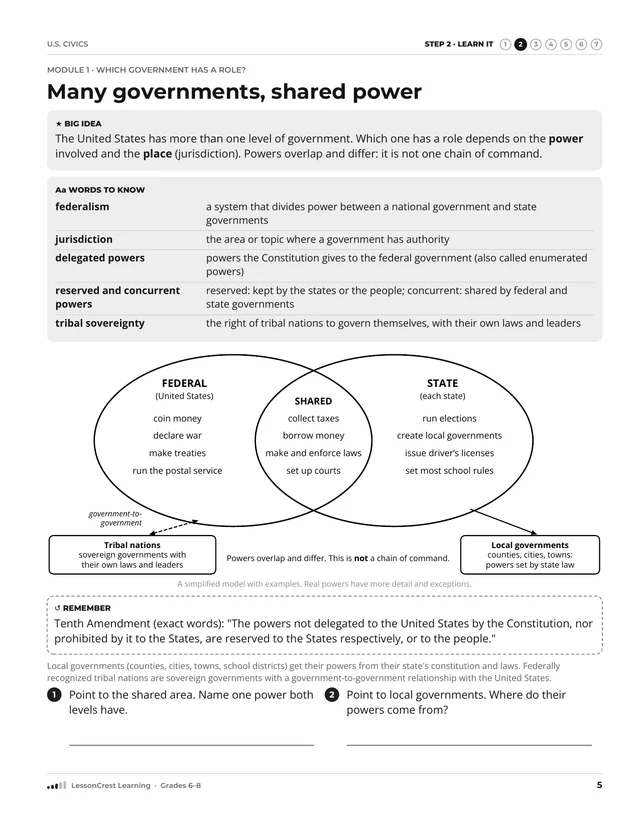
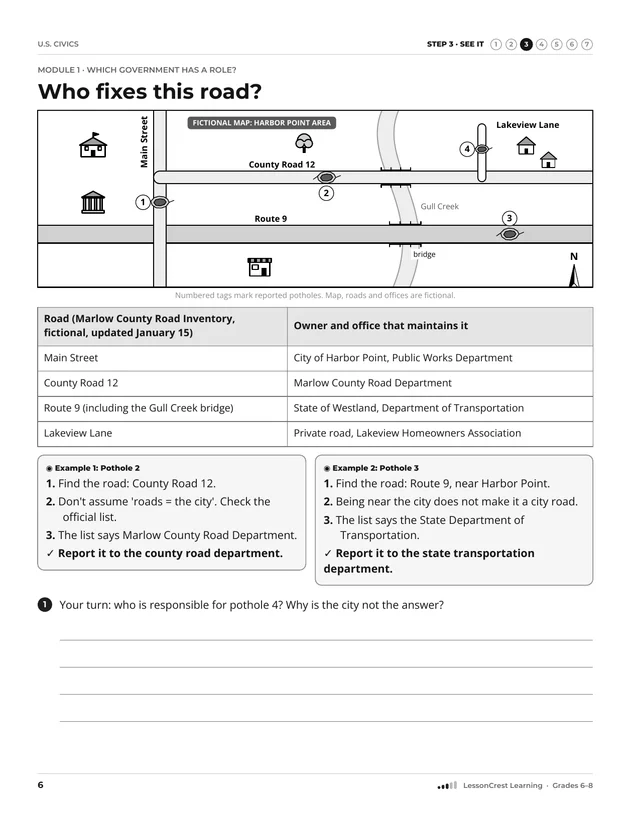
What this book covers
Covered
What you will learn. How federal, state, local and tribal governments share power; how the three federal branches check one another; how proposals become statutes, regulations, court decisions and local ordinances; and how to check civic claims and take part in lawful, age-appropriate ways.
Not covered
What this book does not do. It does not tell you what to think about any policy, it names no current officeholders, and it is not legal advice.
Before you start, you should be able to
- Read a short informational text and say its main point
- Find who issued a document and when
- Tell a fact from an opinion, and a rule from a preference
Notices
This book teaches how U.S. government works in general terms. It is not legal advice and does not take sides on any policy. Local places, offices, ordinances, notices and dates are fictional; real procedures vary, so check the official source for your own community.
Pictures in this book are simplified learning models. Check answers with the explanations at the back of the book.
The steps in this book
- Step 1: Get Ready
Check the reading and source skills you need first. An adult helps you choose where to start.
- Step 2: Learn It
Read a short, plain explanation, a labeled model and the key words.
- Step 3: See It
Follow a worked example that shows the thinking, one step at a time.
- Step 4: Try It Together
Practice with prompts and help cues. The help gets smaller as you go.
- Step 5: On Your Own
Practice on your own with varied cases, then explain your reasoning.
- Step 6: Look Back
Revisit earlier learning, check your progress and choose a next step.
- Step 7: Check and Fix
Check answers. Each one explains why, names a common mistake and gives a help step.
What is in the book
The modules
- Module 1: Which government has a role?Pages 5–14
- Module 2: Branches, powers, and constraintsPages 15–24
- Module 3: From proposal to public implementationPages 25–34
- Module 4: Evidence, rights, and participationPages 35–44
Contents
- Readiness check, pp. 3–4. Before Module 1. Its table tells you where to start.
- Modules, pp. 5–44
- Checkpoints, pp. 14, 24, 34, 44. The last page of each module.
- Mixed review, pp. 45–48. Questions from across the book, mixed together.
- Exit check, pp. 49–50. A last check across the book.
- Reflect and repair, p. 51
- Try again, p. 52. Fresh questions like those in the exit check.
- Answers and explanations, pp. 53–64. Notes in this part are headed “Why”, “Common mistake”, “Help” and “Look for”.