Coding without Screens
Put Steps in Order
Plan it, trace it, test it, fix it.
Students read and build small block programs with events, loops, conditions and variables, trace every step on paper, and debug with evidence instead of guessing. Every task works unplugged, with optional runnable extensions.
Works fully on paper, with explained answers
Covered
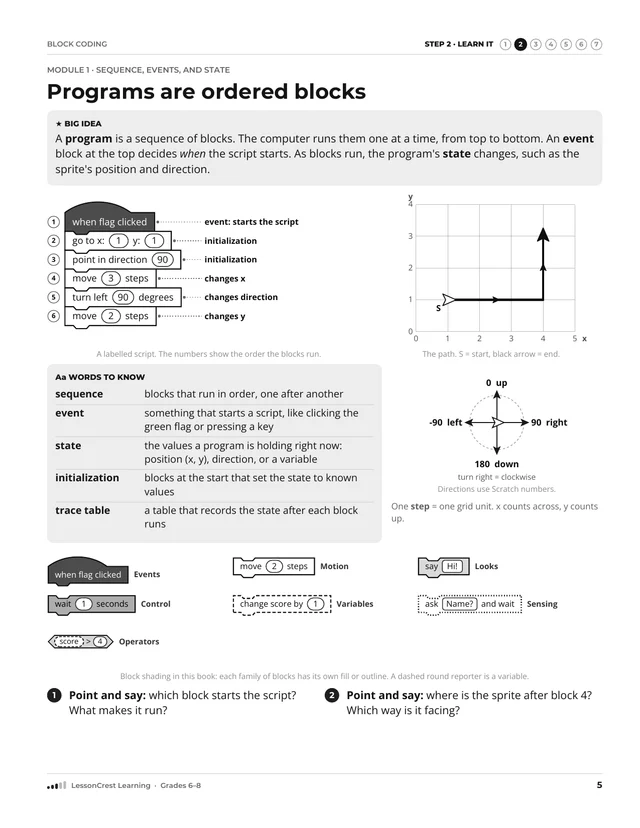
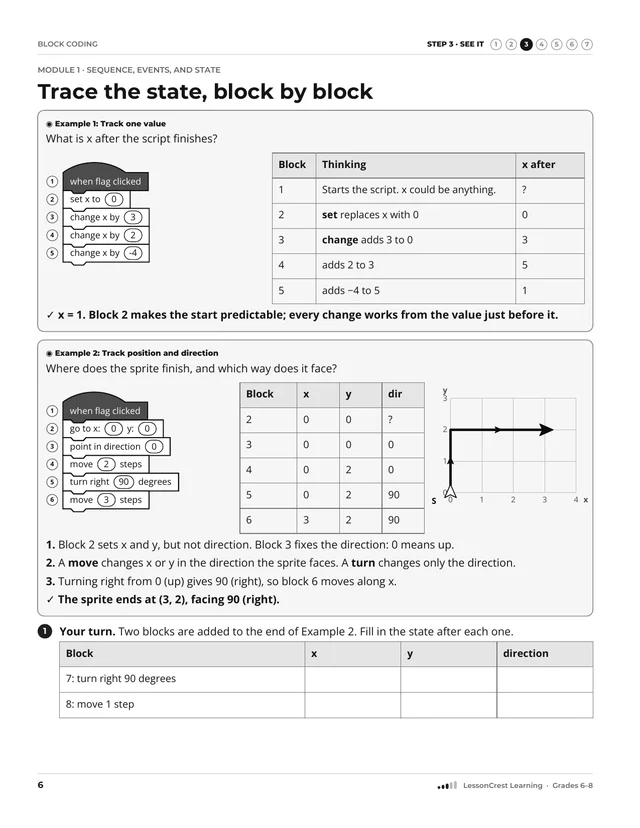
- Sequence, events and starting state (Module 1)
- Counted loops and repeat-until loops (Module 2)
- If/else, comparisons, variables and input (Module 3)
- Test cases, first divergence and debugging logs (Module 4)
Not covered
Not covered: lists, cloning, broadcasting messages, text programming languages.
Before you start, you should be able to
- Follow instructions in order, one at a time
- Read a point on a grid as (x, y): across first, then up
- Say whether a comparison like 7 > 5 is true or false
- Tell the difference between a plan and what actually happened
Things to have
- Pencil, eraser, and a coin or counter to act as the sprite
- No computer needed.
- Every task works fully unplugged, traced on paper with grids and trace tables.
- Optional Run it notes use Scratch 3.0 (scratch.mit.edu, checked October 2026) as an example platform.
Notice
Pictures in this book are simplified learning models. Check answers with the explanations at the back of the book.
Check the skills you need before you begin. If something feels tricky, an adult can help you start in the right place.
Read a short, clear explanation of the new idea and the words that go with it.
Watch the idea being used, one step at a time, in a worked example.
Practice with prompts and help cues. The help gets smaller as you get stronger.
Practice on your own with different kinds of questions, and explain your thinking.
Look back at earlier learning so it stays strong, then check where to go next.
Check your answers. Each answer explains why, names a common mistake, and shows how to fix it.
Put Steps in Order
Trace, Write, and Debug