Personal Finance: Credit, Interest, and Borrowing Costs
Compare Borrowing Offers by Total Cost
Know where the money goes, and when.
Teens build fictional monthly budgets from net income, plan fixed and variable expenses and savings goals, map bills and paydays on a cash-flow calendar, and adjust the plan when real results change. Education, not financial advice.
Fictional scenarios with fully worked answers
Covered
- Goal. By the end of this book you will build a balanced monthly budget and a dated cash-flow calendar for a fictional person or household, then revise both after a realistic change in income or expenses.
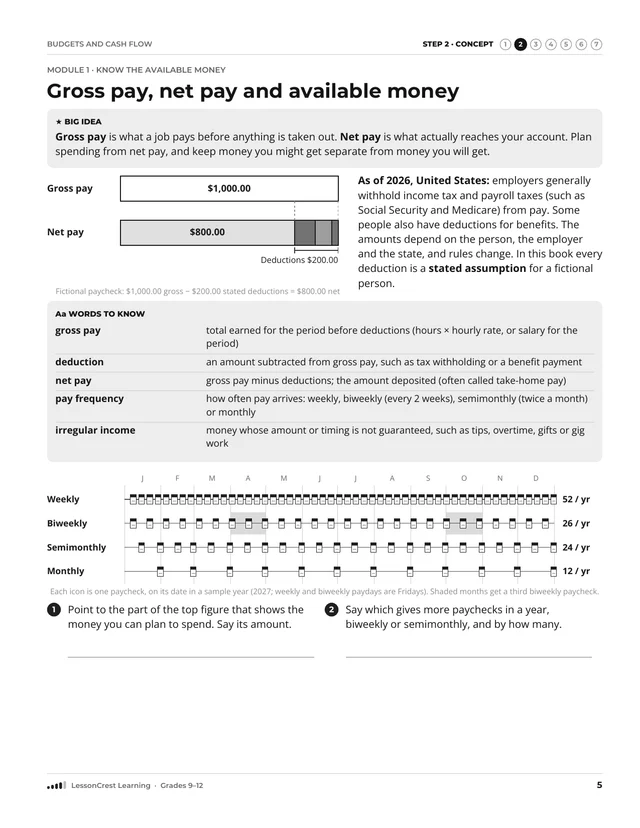
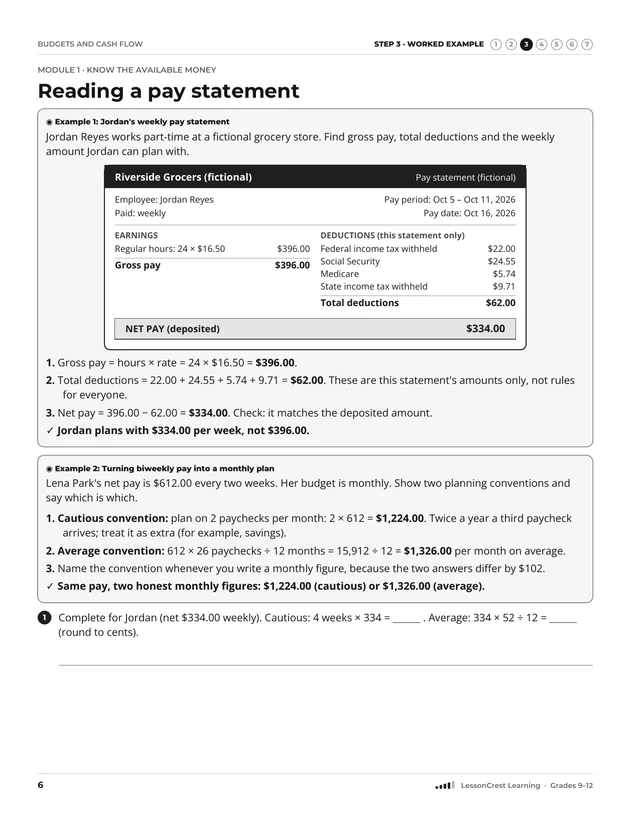
- In scope: gross and net pay, pay frequency, regular and uncertain income, expense categories, reserves for nonmonthly bills, savings goals, running balances, timing gaps, and plan-versus-actual reviews.
Not covered
Not covered: filing taxes, credit and interest (see the LessonCrest credit title), investing, or choosing real financial products.
Before you start, you should be able to
- Add and subtract amounts with cents
- Find a percentage of an amount
- Read dates and tables
- Tell a recurring amount from a one-time amount
Things to have
- Pencil, eraser, calculator and a ruler for tables.
- A calculator is always allowed. The skill being taught is planning, not mental arithmetic.
Notice
Education, not advice. This book teaches planning skills. It is not financial, tax or legal advice for any real situation.
Notice
Pictures in this book are simplified learning models. Check answers with the explanations at the back of the book.
Check the skills you need before you begin. If something feels tricky, an adult can help you start in the right place.
Read a short, clear explanation of the new idea and the words that go with it.
Watch the idea being used, one step at a time, in a worked example.
Practice with prompts and help cues. The help gets smaller as you get stronger.
Practice on your own with different kinds of questions, and explain your thinking.
Look back at earlier learning so it stays strong, then check where to go next.
Check your answers. Each answer explains why, names a common mistake, and shows how to fix it.
Compare Borrowing Offers by Total Cost